“Senegal, embrace Him, and He will exalt you!”
Cherish her, and she will exalt you; embrace her, and she will honor you.(Proverbs 4:8,NIV)
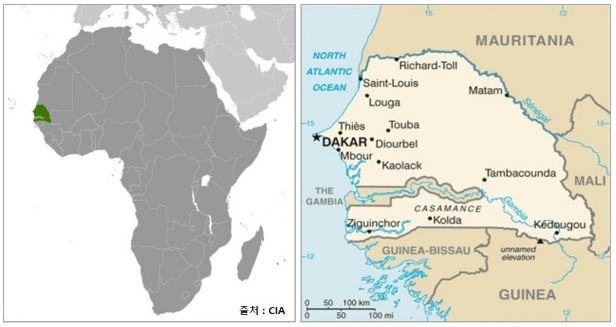
》 Country Profile
Continent | Africa
Population | 17.92 million
Area | 196,722㎢, Located on the Atlantic coast of northwestern Africa.
Capital City | Dakar (3.34 million people)
People Groups | Total 55 groups (Wolof 33.7%, Fulbe (Fulani) 22.8%, Serer-Sine 10.5%, Maninka 10.5%, Mandingo 5.7%, Jola 3.2% )
Unreached People Groups | 26 Groups (80.2% of the population)
Official Language(s) | French (official), Wolof
Total Languages | 50
Bible Translations | Completed 11, New Testament 18, Partial 11
Religion | Christianity 4.6% (0.2% Protestant, 4% Catholic), Islam 90.5%, Ethnic religions 4.5% Evangelical 0.2% (350,000 people)
》 About Senegal
Senegal was first settled by the Tukuro people in the 9th century, and in the 11th century, the Zenaga people from the north introduced Islam, which influenced the region and became the origin of the name “Senegal”. From the 15th century onward, Portugal, the Netherlands, France, and Britain engaged in coastal trade, using Gorée Island as a base for the transatlantic slave trade. During its peak, more than a third of Senegal’s population was enslaved. France officially abolished the slave trade in 1815, and slavery was fully outlawed in 1848, though illegal slave trading continued for several years. In 1895, Senegal became part of French West Africa, gaining independence in 1960. Under the leadership of President Léopold Sédar Senghor, the country experienced political and social stability until he stepped down in 1980 due to old age. In 1982, Senegal formed a nominal union with Gambia (Senegambia), but the integration was never realized, and the union dissolved in 1989. Today, Senegal is a presidential republic, and in the 2024 presidential election, Bashir Diomaye Faye of the Pastef party was elected as the new head of state.
Senegal’s economy is driven by mining, construction, tourism, fisheries, and agriculture. Phosphate mining, fertilizer production, agricultural exports, and fishing are major industries, and the country is actively pursuing oil exploration projects. Senegal’s top exports include peanuts and phosphates, while tuna, octopus, squid, skipjack tuna, and shrimp are key seafood products, most of which are exported. The country heavily depends on foreign aid, remittances from expatriates, and foreign direct investment. Key infrastructure projects include the Tiestouba Highway, a new international airport (opened in 2017), and energy sector upgrades. However, high electricity prices remain a major obstacle to economic growth, with some of the highest energy costs in the world. Despite political stability and steady economic growth, poverty and high unemployment push many Senegalese to attempt illegal migration to Europe in search of better opportunities. As a result, the nation relies significantly on remittances and foreign economic aid.
Senegal’s GDP per capita is approximately $1,743.
》 Scripture Focus
| Proverbs 4:4-10(NIV) 4 Then he taught me, and he said to me,“Take hold of my words with all your heart; keep my commands, and you will live. 5 Get wisdom, get understanding; do not forget my words or turn away from them. 6 Do not forsake wisdom, and she will protect you; love her, and she will watch over you. 7 The beginning of wisdom is this: Get wisdom. Though it cost all you have, get understanding. 8 Cherish her, and she will exalt you; embrace her, and she will honor you. 9 She will give you a garland to grace your head and present you with a glorious crown.” 10 Listen, my son, accept what I say, and the years of your life will be many. |
》 Prayer Points
1. Senegal is predominantly Muslim, with 90% of the population adhering to Islam. Christians make up less than 5%, most of whom are Catholics, while evangelicals account for just 0.2% (around 320,000 people). Let us give thanks that church planting efforts by organizations such as the Assemblies of God (AoG), New Tribes Mission (NTM), and the International Mission Board (IMB) have led to an increase in believers among the Serer, Bassari, Balanta, and Jola tribes. The Evangelical Council of Senegal (FES), which has been government-approved since 1968, oversees over 200 churches and 50 mission organizations. There are also theological and training institutions such as the Senegal Evangelical Theological Seminary (ITES), the Assemblies of God Theological Seminary, and the West African Theological Institute (WATI), along with 20 other Bible education centers that train pastors and leaders. Let us pray for the small evangelical churches in Senegal, that they may break through the spiritual oppression among Muslims through prayer and become faithful witnesses, glorifying the gospel by living in obedience to Christ.
2. Let us thank God for the many missionaries and mission organizations serving in Senegal. Groups like NTM, IMB, AoG, WEC, SIM, the Finnish Lutheran Church, YWAM, and UWM have shared the gospel in Senegal and neighboring countries. Let us praise God for the growing number of missionaries from Latin America, Africa, and Asia joining the work. WEC began ministry among the Fula people in Casamance in 1936 and now reaches Muslims in the north. SIL plays a key role in Bible translation and literacy in tribal languages. In Senegal, the Evangelical Fraternity oversees many church-planting groups nationwide. Mission Inter-Senegal also trains local evangelists and church planters. Let us pray that missionaries and churches will hold fast to the message of the cross and become channels of life that bring glory to the gospel. More than 85% of Senegalese Muslims follow Sufi Islam, a deeply rooted and influential movement. Let us pray for unity and boldness as missionaries and churches proclaim Jesus Christ, the source of wisdom and understanding, to those who have never heard.
3. Senegal is a young nation, with 40% of the population under 15 years old and over 60% under 25 years old. Compared to older generations, many young people are less committed to Islam, making them more open to the gospel. The student ministry (GBUSS/IFES meetings) in Dakar is experiencing spiritual revival. Let us pray that the youth of Senegal will discover the eternal value of God’s Word, dedicating their lives fully to Christ and choosing eternal treasures over temporary gains. Many Senegalese attempt illegal migration to Europe, risking dangerous sea voyages each year. Many die at sea or are forcibly repatriated. Let us pray that young people will find true hope in Christ, rather than seeking a future through illegal immigration. May God protect those crossing the sea and may He provide safe passage so that they may have the opportunity to accept the gospel.
》 Urgent prayer requests around the world need your prayer!