“Cape Verde is from God and is in Christ Jesus!”
It is because of him that you are in Christ Jesus, who has become for us wisdom from God—that is, our righteousness, holiness and redemption.(1 Corinthians 1:30,NIV)
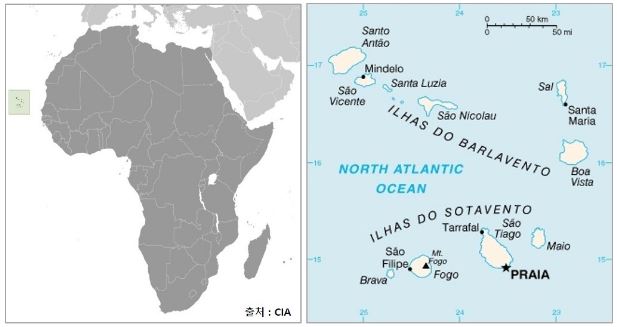
》 Country Profile
Continent | Africa
Population | 590,000
Area | 4,033㎢, Comprising 15 islands in the Atlantic Ocean, located about 450㎞ west of Senegal in northwestern Africa
Capital City | Praia (170,000 people)
People Groups | Total 5 groups, Creole (Mulatto) 71%, African 28%, European 1%
Unreached People Groups | 1 group, Fulani (12.5% of the population)
Official Language(s) | Portuguese, Portuguese Creole (Cabovedianu)
Total Languages | 5
Bible Translations | Completed 2, New Testament 1, Partial 1
Religion | Christianity 84.8% (4% Protestant, 79% Catholic), Muslim 11.4%, Non-religious 0.8%, Evangelical 8.2% (50,000 people)
》 About Cape Verde
Cape Verde was discovered by Portugal in 1456 and became a center for the slave trade under Portuguese rule. It fought for independence along with Guinea-Bissau, another Portuguese colony, but chose not to unify and became independent on its own in 1975. Today, Cape Verde is known as one of the most stable democracies and economies in Africa. Since 1998, it has used the euro. In the late 20th century, repeated famines and epidemics caused high death rates and led many people to emigrate, causing large shifts in population. It is a parliamentary republic, with José Maria Neves serving as president since 2021 and Ulisses Correia e Silva in his second term as prime minister.
Cape Verde’s economy depends on foreign aid, investment, remittances, and tourism, which fluctuates with the European economy. Due to drought and water shortages, farming is very limited, and most food products must be imported. Key exports include coffee, corn, and peanuts. Despite having good fishing resources like tuna and lobster, they are not fully used. One-third of the population lives in poverty, and the government relies on international food aid. Around 350,000 Cape Verdeans live abroad, mostly in the U.S., Angola, and Senegal. In 2021, the World Bank gave a $30 million loan to support green recovery after the COVID-19 crisis.
Cape Verde’s GDP per capita is approximately $4,475.
》 Scripture Focus
| 1 Corinthians 1:26-31(NIV) 26 Brothers and sisters, think of what you were when you were called. Not many of you were wise by human standards; not many were influential; not many were of noble birth. 27 But God chose the foolish things of the world to shame the wise; God chose the weak things of the world to shame the strong. 28 God chose the lowly things of this world and the despised things—and the things that are not—to nullify the things that are, 29 so that no one may boast before him. 30 It is because of him that you are in Christ Jesus, who has become for us wisdom from God—that is, our righteousness, holiness and redemption. 31 Therefore, as it is written: “Let the one who boasts boast in the Lord.” |
》 Prayer Points
1. Although 79% of Cape Verde’s population is Catholic, many people still follow superstition and African traditional religion. Heretical groups such as Mormons, Seventh-day Adventists, and Jehovah’s Witnesses arrived early and have grown steadily. The Church of the Nazarene and the Baptist denomination are among the oldest Protestant churches, and many Pentecostal churches from Brazil and the U.S. have been established. Evangelicals make up about 8.2% of the population (around 50,000 people), but many churches are influenced by secularism and prosperity teachings, and the lack of strong biblical teaching makes it easy for false teachings to spread.
Let us pray that faithful ministers and believers will rise up to preach the gospel of the cross in Cape Verde, and that churches, ministries, and Bible schools will be established to train them with God’s Word and prayer. May God, who chooses the weak things of the world to shame the strong, bless this nation and raise it up as a priestly nation.
2. Because Cape Verde is a remote island nation, it is difficult for missionaries to settle there. Most of those who do come tend to work in cities, avoiding the poorer and more rural areas. Although the majority of the population speaks Cape Verdean Creole (Kabuverdianu), there is still no complete New Testament in that language.
Let us pray that Bible translation into Cape Verdean Creole will be completed quickly, so that people can clearly hear and believe in God’s Word.
3. Due to poverty, limited educational opportunities, and repeated droughts, over 350,000 Cape Verdeans have migrated abroad, especially to the United States, Portugal, Senegal, and Angola.
Let us pray that Cape Verdean immigrants will come to know Jesus and be saved in the countries where they live. May they become channels of the gospel, bringing the good news of Jesus Christ back to their homeland.
》 Urgent prayer requests around the world need your prayer!