“For Serbia’s life is hidden with Christ in God!”
For you died, and your life is now hidden with Christ in God.(Colossians 3:3,NIV)
》 Country Profile
Continent | Europe
Population | 7,049,000
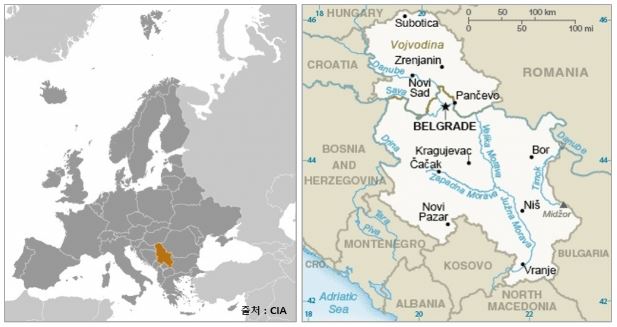
Area | 77,474㎢, Located in the central part of the Balkan Peninsula in southeastern Europe.
Capital City | Belgrade (1.4 million)
People Groups | Total 35 Groups, Serbs 87.5%, Hungarians 2.7%, Romani 2.2%, Bosnians 1.5%, others 6.1%
Unreached People Groups | 6 (1.7% of the population)
Official Language(s) | Serbian
Total Languages | 31
Bible Translations | Completed 23, New Testament 2, Partial 2
Religion | Christianity 79.2% (3% Protestant, 70% Orthodox), Muslim 16.4%, Non-religious 4.2% Evangelical 0.7%(50,000 people).
》 About Serbia
Serbia began in the 6th century with the formation of South Slavic tribal states. In the medieval period, a Serbian kingdom was established around Kosovo but fell to the Ottoman Turks in 1459, marking the end of the medieval era. Serbia regained independence in 1878 with Russian support after the Russo-Turkish War. Through victories in the Balkan Wars (1912–1913), it expanded its territory and became a key Balkan state. After World War I, Serbia helped form the Kingdom of Serbs, Croats, and Slovenes in 1918. Post World War II, Serbia became a major republic in the Socialist Federal Republic of Yugoslavia under Josip Tito. After Tito’s death in 1980, ethnic tensions resurfaced. In 1991, the secession of Slovenia and Croatia led to civil war. Bosnia followed in 1992, effectively breaking up the federation. Serbia and Montenegro then formed the Federal Republic of Yugoslavia. In 1999, Serbia faced 79 days of NATO airstrikes over Kosovo due to anti-Western policies and oppression of Albanians under Milošević. He was eventually overthrown in 2000. In 2006, Montenegro seceded, making Serbia a standalone republic. Kosovo declared independence in 2008, which Serbia does not recognize. Serbia is a parliamentary republic with Aleksandar Vučić serving as president since 2017, and Đuro Macut serving as prime minister since April 2025.
Serbia’s economy struggled after the wars and NATO bombings in the 1990s but grew quickly after 2008 thanks to foreign direct investment, especially from EU countries. The GDP structure consists of 13% primary industries (agriculture and mining), 22% secondary (manufacturing and construction), and 65% tertiary (services). It has rich deposits of coal (mostly lignite), oil, and natural gas. Unemployment peaked at 20% in 2014 but improved to 10.9% by 2019. Positive growth factors include ongoing EU accession reforms, a strategic location, skilled and affordable labor, and free trade agreements with CEFTA countries. However, challenges remain in judicial inefficiency, corruption, and an aging population.
Serbia’s GDP per capita is approximately $13,523.
》 Scripture Focus
| Colossians 3:1–5, 9–10(NIV) 1 Since, then, you have been raised with Christ, set your hearts on things above, where Christ is, seated at the right hand of God. 2 Set your minds on things above, not on earthly things. 3 For you died, and your life is now hidden with Christ in God. 4 When Christ, who is your life, appears, then you also will appear with him in glory. 5 Put to death, therefore, whatever belongs to your earthly nature: sexual immorality, impurity, lust, evil desires and greed, which is idolatry. 9 Do not lie to each other, since you have taken off your old self with its practices 10 and have put on the new self, which is being renewed in knowledge in the image of its Creator. |
》 Prayer Points
1. Although 70% of the Serbian population identifies as Orthodox, most are nominal believers. For many, religion is more about tradition and national identity than a living faith. Folk beliefs such as fate and fortune-telling are often blended with Orthodox practices. The Orthodox Church has enforced restrictive laws to maintain religious dominance, and non-Serbian Orthodox churches have been targeted, with Muslims and Protestants sometimes labeled as traitors. Protestants make up about 3% of the population, and evangelicals around 50,000 people (1.7%), largely among ethnic minorities such as Hungarians and Slovaks in Vojvodina. Many church leaders lack training due to poverty. Let us pray for participation in leadership development programs such as the Belgrade Bible School, Novi Sad Seminary, and the Timothy Project. May the Orthodox Church repent from division and the Protestant Church be renewed in knowledge and united in Christ.
2. Organizations such as GEM, IMB, and ECM are present in Serbia but face challenges in long-term missions. Others, like Bread of Life and Eurovangelism, work with war refugees, providing aid and healing. With growing numbers of migrants from the Middle East and Africa, the church must awaken to its evangelistic calling. Let us pray for missionaries to serve with the heart of Christ, and for churches to remain unified in faith, boldly proclaiming the gospel throughout Serbia and beyond.
3. Many Serbs emigrated to Europe and North America due to war and hardship but continue to struggle abroad. Let us pray for their salvation through the gospel. In Serbia, children and youth are being reached through ministries like CEF and IFES, while Teen Challenge Serbia addresses drug addiction by rehabilitation and the power of gospel. There are around 150,000 Roma (Gypsies) in Serbia. Many have come to faith through evangelical churches, yet materialism remains a strong temptation. Let us pray that the next generation turns from the legacy of war and division and seeks the eternal kingdom of God. May the Roma live as those crucified and raised with Christ, bringing glory to the Lord.
》 Urgent prayer requests around the world need your prayer!