“Seek the Lord while he may be found; call on him while he is near!”
Seek the LORD while he may be found; call on him while he is near. (Isaiah 55:6,NIV)
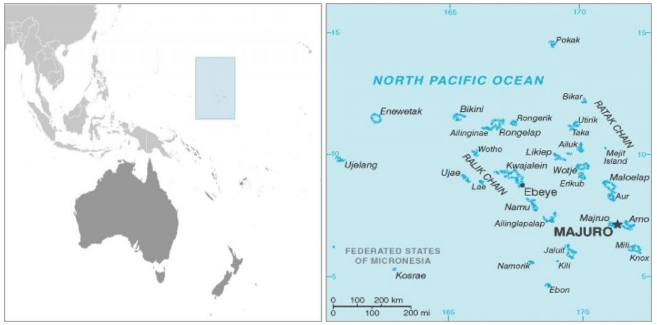
Marshall Islands
》 Country Profile
Continent | Oceania
Population | 80,000
Area | 181㎢, Consists of 1,156 islands and 34 coral atolls spread across nearly 2 million ㎢ in the western Pacific.
Capital City|Majuro (31,000)
People Groups | Total 6 groups, Micronesians (Marshallese) 89.3%, Americans 6.6%, Pacific Islanders 2.3%
Unreached People Groups | 1 (Japanese 400)
Official Language(s) | Marshallese, English
Total Languages | 5
Bible Translations | Completed 4
Religion | Christianity 95.3% (Protestant 82%, Catholic 7%), Non-religious 1.6%, Ethnic religion 0.5%, Buddhism 0.5%, Evangelical 52.9%(41,000)
》 About The Marshall Islands
The Marshall Islands were first charted by a Spanish expedition in 1526 and claimed in 1592. The islands were named after British Captain John Marshall, who visited in 1788. Since the 1820s, whalers, traders, and slavers have visited, leading to conflicts with indigenous people. From 1857, American Protestant missionaries helped convert the population to Christianity, weakening traditional chiefs. Germany declared a protectorate in 1886 but focused mainly on copra trade; full administrative control only came in 1906. In WWI, Japan occupied the islands. After WWII, they fell under U.S. trusteeship, and Bikini and Enewetak became nuclear testing sites. In 1982, a “Compact of Free Association” with the U.S. was signed, coming into effect in 1986, granting de facto independence. The Marshall Islands are a mixed presidential-parliamentary republic, and Hilda Heine has served as President since January 2024.
The country’s economy relies heavily on U.S. aid—especially lease and grant revenue linked to the Compact of Free Association and the military use of Kwajalein Atoll. Agriculture is self sustaining, and industries are limited to handicrafts, tuna processing, and copra. Although tourism shows potential, it remains underdeveloped. In 2003 the United States and the Republic of the Marshall Islands renegotiated aid arrangements covering the period 2004–2023 for a 20-year term, under which the Marshall Islands will receive roughly US 1.5 billion in direct support.
The Marshall Islands’ GDP per capita is approximately $5,813.
》 Scripture Focus
| Isaiah 55:6–13(NIV) 6 Seek the LORD while he may be found; call on him while he is near. 7 Let the wicked forsake their ways and the unrighteous their thoughts. Let them turn to the LORD, and he will have mercy on them, and to our God, for he will freely pardon. 8 “For my thoughts are not your thoughts, neither are your ways my ways,” declares the LORD. 9 “As the heavens are higher than the earth, so are my ways higher than your ways and my thoughts than your thoughts.” 10 As the rain and the snow come down from heaven, and do not return to it without watering the earth and making it bud and flourish, so that it yields seed for the sower and bread for the eater, 11 so is my word that goes out from my mouth: It will not return to me empty, but will accomplish what I desire and achieve the purpose for which I sent it. 12 You will go out in joy and be led forth in peace; the mountains and hills will burst into song before you, and all the trees of the field will clap their hands. 13 Instead of the thornbush will grow the juniper, and instead of briers the myrtle will grow. This will be for the LORD’s renown, for an everlasting sign, that will endure forever. |
》 Prayer Point
1. The church must be restored. Although the majority of the Marshall Islands’ population identifies as Protestant and 52% are evangelicals—giving the church significant influence across society—they are not living as true disciples of the Lord. The United Church of Christ, effectively the national church, is losing both membership and spiritual vitality. The Assemblies of God grew rapidly but has since fractured. Meanwhile, cults such as Mormonism, Jehovah’s Witnesses, and the Baháʼí are actively proselytizing. The islands also face serious challenges like over-urbanization, unemployment, drug abuse, sexual immorality, high birth rates, and financial collapse among leaders. Let us pray that the church will call the wicked to forsake their ways and the unrighteous their thoughts, that the people may return to the Lord, seek Him while He may be found, and call upon Him while He is near—so that salvation and restoration may come to the islands.
2. Like many other Pacific island nations, the Marshall Islands are experiencing severe effects from climate change. Rising sea levels have submerged more than 20 meters of shoreline, saltwater has killed trees, and the environment is changing rapidly. Concrete seawalls are being built, but 35% of the population has already left. Those remaining cannot easily relocate and are appealing to the international community to remember them. As they face the fear and sorrow of losing their homeland, let us pray that the people of the Marshall Islands will seek the Lord, the sovereign over all creation, and ask for His wisdom and help.
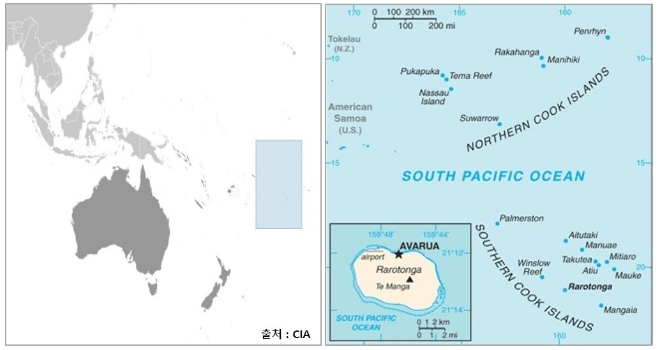
Cook Islands
》 Country Profile
Continent | Oceania
Population | 8,100
Area | 236㎢, A self-governing territory of New Zealand in the South Pacific.
Capital City|Avarua (7,000)
People Groups | Total 7 groups: Polynesians 91.1% (Cook Islands Māori 72.2%), Euronesians 4.5%, Europeans 3.9%
Unreached People Groups | 0
Official Language(s) | English, Cook Islands Māori
Total Languages | 6
Bible Translations | Completed 3
Religion | Christianity 97.7% (Protestant 66%, Catholic 16%), Non-religious 1.9%, Baháʼí 0.4%
Evangelical 13.6% (1,100 people)
》 About The Cook Islands
The Cook Islands were first settled in the 13th century by Polynesians from what is now French Polynesia and Samoa. In 1773, British explorer Captain James Cook landed on the islands, and they were later named in his honor. Contact with Europeans increased through missionaries, leading to the rapid spread of Christianity—especially in the southern islands—as local chiefs converted. The islands became a British protectorate in 1888 and were annexed by New Zealand in 1901. In 1965, the Cook Islands entered into a free association agreement with New Zealand and became self-governing. They operate under a parliamentary democracy and recognize the British monarch as head of state. Mark Brown has served as Prime Minister since 2022. Due to migration to New Zealand, the population has dropped by more than half over the past decade.
The economy of the Cook Islands has a relatively high per capita GDP compared to other Pacific nations. Tourism is the leading industry, accounting for a significant portion of GDP. Black pearls are a notable export, and around one-third of the labor force is employed in agriculture, growing copra, papaya, pineapple, and tomatoes. Other sources of income include remittances, development aid from New Zealand, and offshore finance. In recent years, the government has pursued international cooperation in sectors such as deep-sea minerals and education. The Cook Islands’s GDP per capita is approximately $25,750.
》 Prayer Points
1. The YWAM base is located in Rarotonga, Cook Islands. Let us pray that evangelicals and mission organizations will stand firm in the truth of the gospel, so they may pray and share the good news with boldness. Let us also pray that the churches become channels of the gospel—never ceasing to proclaim the salvation of Jesus Christ, the Redeemer of the island people, to both the living and the dead.
2. Many islanders have migrated to New Zealand in search of jobs. Those who remain are left in isolation and vulnerability, yet they are not forgotten in the heart of the Lord. Let us pray for them.
Let us also pray that the gospel will reach those who have immigrated to Auckland and other cities in New Zealand, so they may find new life in Christ and return to their homeland. May the Cook Islands become islands that inherit the kingdom of God.
》 Urgent prayer requests around the world need your prayer!