“Since God so loved us, we also ought to love one another!”
Dear friends, since God so loved us, we also ought to love one another.(1 John 4:11,NIV)
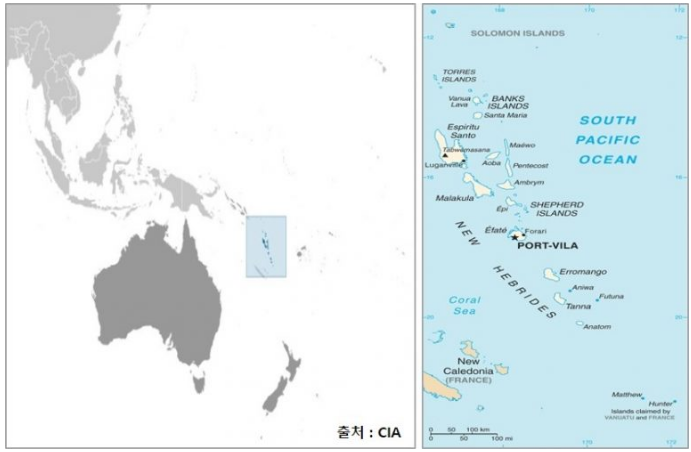
》 Country Profile
Continent | Oceania
Population | 308,000
Area | 12,189㎢, There are 12 large islands and 70 small islands in the southeastern part of the Solomon Islands in the South Pacific, but 65 of them are uninhabited.
Capital City|Port Vila (53,000 people)
People Groups | Total 111 groups, Ni-Vanuatu Groups: 99.2% (detribalized Melanesians, Lenakels, Hanos, Bislama, Faama, etc.), Other Oceanians 0.8%
Unreached People Groups | 0
Official Language(s) | Bislama (Pidgin English), English, French
Total Languages | 109
Bible Translations | Completed 15, New Testament 18, Partial 29
Religion | Christianity 91.1% (Protestant 72.9%, Catholic 11.5%), Ethnic religion 5.6%, Non-religious 1.2%, Buddhism0.3%, Islam 0.1%, Evangelicals 41.4%(125,000 people)
》 About Vanuatu
Vanuatu was first discovered by a Spanish expedition in 1606 and later explored by British Captain James Cook in the 18th century, who named it the New Hebrides Over time, both Britain and France sought control of the islands, eventually establishing a joint naval commission in 1887 and formalizing a condominium (a joint colonial administration) in 1906. During this period, over half of the indigenous men were taken to Australia for forced labor. In World War II, as Japan invaded Melanesia, the United States stationed up to 50,000 troops in Vanuatu to block further advancement. After the war, movements like the “John Frum” movement emerged, blending political and religious beliefs. Independence efforts began in the 1960s, and in 1980 Vanuatu gained full independence with support from Britain and France. The name “Vanuatu” means “Our Land.” Political unrest and factional conflict persisted from 1997 to 2004, but the country has stabilized since. It is a republic, with the president as the head of state and the prime minister holding executive power. Since 2022, Nikenike Vurobaravu has served as president and Ishmael Kalsakau as prime minister.
Vanuatu’s economy is primarily based on small-scale agriculture, with about two-thirds of the population relying on it. Tourism has grown, with over 330,000 visitors in 2017, and continues to expand thanks to improved infrastructure. Key income sources include tourists from Australia and New Zealand, as well as foreign aid. However, limited exports, frequent natural disasters, and its remote location remain major challenges to sustained economic growth.
Vanuatu’s GDP per capita is approximately $3,542.
》 Scripture Focus
| 1 John 4:11–16(NIV) 11 Dear friends, since God so loved us, we also ought to love one another. 12 No one has ever seen God; but if we love one another, God lives in us and his love is made complete in us. 13 This is how we know that we live in him and he in us: He has given us of his Spirit. 14 And we have seen and testify that the Father has sent his Son to be the Savior of the world. 15 If anyone acknowledges that Jesus is the Son of God, God lives in them and they in God. 16 And so we know and rely on the love God has for us. God is love. Whoever lives in love lives in God, and God in them. |
》 Prayer Point
1. Vanuatu’s motto is “We stand in God.” In 2006, the nation was rededicated to God, marking 400 years since it was called “The Great South Land of the Holy Spirit.” About 73% of the population identifies as Protestant, and 41% are considered evangelical. Most churches belong to the Vanuatu Christian Council.
However, many are only Christians in name, and cults like Mormonism, Jehovah’s Witnesses, and the Unification Church are spreading. Youth are drifting from the church. Let us pray that churches teach “the Gospel of the cross” clearly and raise obedient disciples. May the seven seminaries train godly leaders and the church become a witness of God’s love.
2. The “John Frum” cargo cult began with the belief that goods from America were gifts from a man named John Frum. Thousands have since turned to Christ, but some islands like Tanna and Santo still follow tribal religions and need the gospel. Meanwhile, cults and other religions are growing. Let us pray that “break free from idol worship” and people stand firm in God. Bible translation and literacy efforts are ongoing through Wycliffe and the United Bible Societies. Pray for wisdom and strength for the translators.
Wallis and Futuna Islands
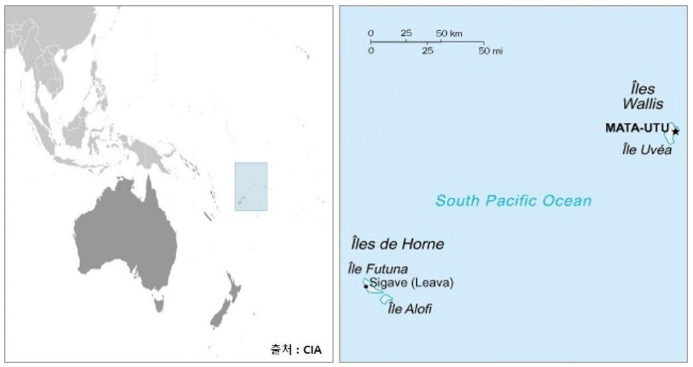
》 Country Profile
Continent | Oceania
Population | 16,000
Area | 142㎢, Consists of three islands: Wallis, Futuna, and Alofi, along with about 20 smaller islands located 300 km west of Samoa in the South Pacific.
Capital City|Mata-Utu (1,000 people)
People Groups | Total 3 groups: Polynesians 96.3% (Wallisians 66.3%, Futunans 30%), French 3.7%
Unreached People Groups | 0
Official Language(s) | French, Wallisian (ʻUvea), Futunan
Total Languages | 3
Bible Translations | Completed 3
Religion | Christianity 98.5% (Protestant 1%, Catholic 94%), Ethnic religion 0.6%, Non-religious 0.6%, Evangelical 1.8% (about 300 people)
》 About Wallis and Futuna Islands
Futuna was discovered by the Dutch in 1616, and Wallis by the British in 1767. The islands later became a French colony in 1842. French Catholic missionaries, who arrived in 1837, were the first Europeans to settle in Wallis and Futuna. By 1842, most of Wallis’s population had converted, and by 1846, so had most of Futuna’s. These missionaries later requested that the French government designate the islands as a protectorate. In 1959, the residents voted to become a French overseas territory, and they officially gained this status in 1961. In 2003, the designation was changed to “French Overseas Collectivity” The French President serves as head of state, and Munipoese Muli’aka’aka has been serving as the territory’s President of the Territorial Assembly since 2022 for a five-year term.
The economy is largely limited to traditional subsistence agriculture, with only 5% of the land suitable for cultivation. About 80% of the population is engaged in farming crops such as coconuts, breadfruit, taro, bananas, pineapples, and oranges, along with raising pigs and goats and fishing. The main sources of income are subsidies from the French government, fishing license fees from Japan and South Korea, and remittances from overseas workers in New Caledonia.
Wallis and Futuna Islands’ GDP per capita is approximately $18,000.
》 Prayer Points
1. In Wallis and Futuna, 94 percent of the population is Catholic, but many follow the faith more out of tradition and formality than from a living relationship with God. Through the work of missionaries from Pentecostal churches in New Caledonia and the Caledonian Missionary Fellowship, a growing number of evangelical believers have come to faith.
Meanwhile many who leave their homeland to work in New Caledonia often fall into a destructive cycle, earning money but becoming trapped in alcohol and drug addiction. Let us pray that the Gospel of the cross will be proclaimed throughout Wallis and Futuna so that anyone who confesses Jesus as the Son of God may experience salvation with God dwelling in them and they in Him.
》 Urgent prayer requests around the world need your prayer!