“The LORD is my strength and my shield; my heart trusts in Him, and He helps me!”
The LORD is my strength and my shield; my heart trusts in him, and he helps me. My heart leaps for joy, and with my song I praise him.(Psalm 28:7,NIV)
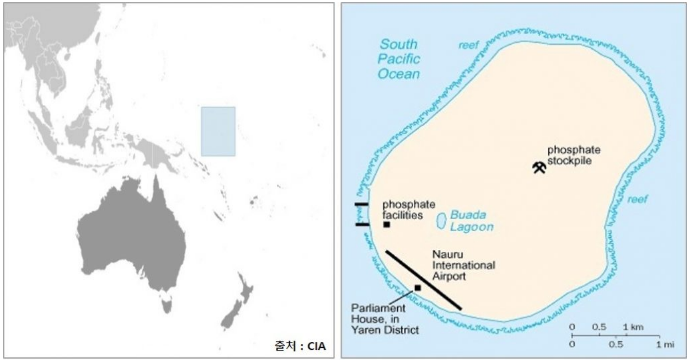
》 Country Profile
Continent | Oceania
Population | 9,811
Area | 21㎢, The world’s smallest independent republic, located on a coral island in the South Pacific.
Capital City|Administrative center: Yaren
People Groups | Total 7 Groups, Micronesians (Nauruans 50%, I-Kiribati 19%) 71%, Chinese 12.7%, Caucasians 6.7%, Tuvaluans 6.7%
Unreached People Groups | 4
Official Language(s) | Nauruan, English
Total Languages | 7
Bible Translations | Completed 7
Religion | Christianity 85.6% (Protestant 50%, Catholic 30%), Non-religious 7.6%, Ethnic religion 5.1%, Buddhism 1.3%, Evangelicals 12.6% (1,200 people)
》 About Nauru
Nauru was traditionally a matriarchal society composed of 12 tribes, two of which disappeared in the early 20th century. The island was discovered by a British merchant ship in 1798 and was later used by European whaling ships as a supply point. Due to the introduction of firearms, inter-tribal wars occurred between 1878 and 1888, reducing the population from 1,400 to 900. In 1886, Nauru came under German influence, and after World War I, it was placed under a League of Nations trusteeship administered by the United Kingdom, Australia, and New Zealand. In 1962, Nauru rejected Australia’s proposal for resettlement and chose independence in 1968. It is now a parliamentary republic, with President David Adeang serving a three-year term since 2023.
Nauru’s economy grew rapidly in 1970 after acquiring phosphate mining assets, and at one point, Nauruans were considered some of the wealthiest people in the world. However, a series of unwise investments in buildings, theaters, and airlines led to a severe financial crisis by around 2000, and the practices were halted in 2005. After primary phosphate deposits were exhausted in 2006, secondary phosphate mining began inland in 2007, with reserves expected to last about 30 more years. Also, in 2012, Australia’s operation of refugee detention centers and income from fishing licenses helped the government recover its finances. Nauru’s GDP per capita is approximately $13,500.
》 Scripture Focus
| Psalm 28:1-2, 6-9(NIV) 1 To you, LORD, I call; you are my Rock, do not turn a deaf ear to me. For if you remain silent, I will be like those who go down to the pit. 2 Hear my cry for mercy as I call to you for help, as I lift up my hands toward your Most Holy Place. 6 Praise be to the LORD, for he has heard my cry for mercy. 7 The LORD is my strength and my shield; my heart trusts in him, and he helps me. My heart leaps for joy, and with my song I praise him. 8 The LORD is the strength of his people, a fortress of salvation for his anointed one. 9 Save your people and bless your inheritance; be their shepherd and carry them forever. |
》 Prayer Point
1. When Nauru’s economy collapsed due to depleted phosphate reserves and the shutdown of offshore banking tied to criminal activity, Christian faith began to grow and spiritual vitality returned. Later, secondary phosphate mining and an Australian refugee facility brought renewed economic hope. Still, unemployment is nearly 90%, and the nation struggles with the world’s highest obesity and diabetes rates. Let us thank God for the growing number of Protestants and evangelicals. The Nauru Independent Church is the largest evangelical body, and all citizens have seen the “Jesus” film.
Let us pray that churches in Nauru will rely on the Lord and that the nation will rejoice in Him and seek His kingdom and righteousness.
New Caledonia
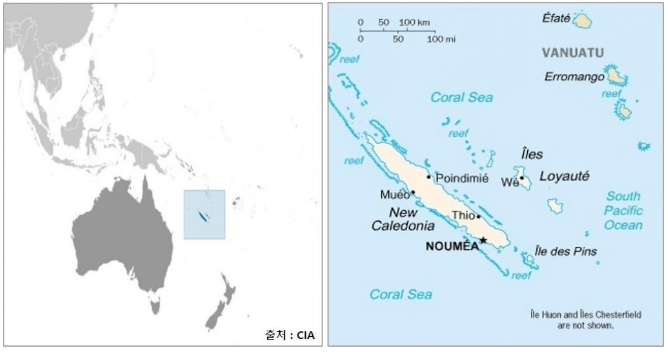
》 Country Profile
Continent | Oceania
Population | 297,000
Area | 18,575㎢, Located 1,400㎞ northeast of Australia in the South Pacific.
Capital City|Noumea (198,000 people)
People Groups | Total 44 Groups, Melanesians (Kanak 41%, Multi-ethnic 10%) 51%, Polynesians (Wallisians 9%, Futunans 5.4%) 16%, Caucasians (French 25%, Italian 3%) 28%, Asians (Javanese 1.8%, Vietnamese 1%) 5%
Unreached People Groups | 0
Official Language(s) | French
Total Languages | 40
Bible Translations | Completed 12, New Testament 3, Partial 2
Religion | Christianity 78.5% (Protestant 15%, Catholic 58%), Non-religious 17.1%, Ethnic religion 1.9%, Islam 0.9% Evangelical 6.2%(18,000 people)
》 About New Caledonia
New Caledonia was discovered in 1774 by British explorer James Cook, who named it after his homeland, Scotland (Caledonia). In 1853, France forcibly annexed the island and turned it into a penal colony, sending over 20,000 convicts across 30 years. After nickel was discovered in 1864, prisoners were used for mining, and workers and enslaved people were brought from Southeast Asia while restricting access for the indigenous Kanak people. When a large amount of nickel were found in 1875, the penal system was abolished. During World War II, it served as a key Allied base, and the U.S. moved its South Pacific command there in 1942. After the war, it became a French overseas territory, and in 1953, French citizenship was granted to all residents. In a 2018 referendum, the population voted to remain under French rule for economic reasons. As of 2025, the President of France remains head of state, Jacques Billant has served as High Commissioner since May 2025, and Alcide Ponga has served as President of the Government since January 2025.
The economy is centered on nickel and chrome resources, with about 11% of the world’s nickel reserves, making it the second-largest holder globally. Falling nickel prices have affected the economy, and because there isn’t much good land for farming, about 20% of food is imported. French financial aid (over 15% of GDP) and tourism also play key roles in development. New Caledonia‘s GDP per capita is approximately $14,800.
》 Prayer Points
1. Let us thank God that most Kanaks have become Christians and that many villages have churches. However, beliefs mixed with animism and formal Catholicism still remain. Catholicism (58%) is mostly nominal and formal. Protestant churches have been divided and wounded—unity through forgiveness is needed. House churches and independent churches are rising in living faith. Let us pray for revival through them, that churches will cry out to the Lord and He will bring salvation and restoration.
2. Javanese and Arab Muslims (0.9%) have barely heard the gospel. Pray that the Wallis, Futuna people, and Caledonians in Nouméa will receive and be discipled in the gospel. Most French residents in cities stay briefly and rarely join church. The Bible Evangelism Club shares the gospel with children. Let us pray that the Lord will save the people of New Caledonia, be their shepherd, and lead them forever.
》 Urgent prayer requests around the world need your prayer!