“Since you have received Christ Jesus as Lord, walk in Him!”
So then, just as you received Christ Jesus as Lord, continue to live your lives in him,(Colossians 2:6,NIV)
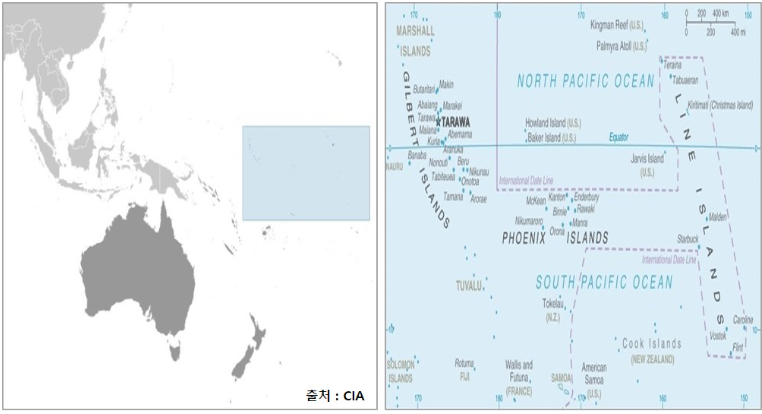
Kiribati
》 Country Profile
Continent | Oceania
Population | 114,000
Area | 811㎢, consisting of 3 archipelagos and 33 atolls in the South Pacific.
Capital City | Tarawa (64,000)
People Groups | Total 5 groups, I-Kiribati 96.2%, others (including people of mixed heritage, Tuvaluans, Europeans) 3.8%
Unreached People Groups | 0
Official Language(s) | English, Kiribati
Total Languages | 4
Bible Translations | Completed 3
Religion | Christianity 98.4% (Protestant 42%, Catholic 54%), Non-religious 0.6%, Evangelical 8.5% (9,600 people)
》 About Kiribati
Kiribati, located at the easternmost point of the International Date Line, is the first country in the world to see the sunrise each day. The islands were first visited by a Spanish explorer in 1606, and later came under British control as a protectorate before being formally annexed as a colony. The Gilbert Islands, named after British naval officer Thomas Gilbert who landed there, gained full independence in 1979 and adopted the name Kiribati. Today, it is a member of the Commonwealth. Due to rising sea levels threatening its land, Kiribati has been actively involved in international efforts to combat climate change. It is a presidential republic, with Taneti Maamau serving as president since 2016. He was re-elected for a second term.
Kiribati has very limited natural resources and remains one of the least developed countries in the Pacific. Its commercially viable phosphate reserves were depleted around the time of independence in 1979. The economy heavily depends on revenue from fishing licenses and remittances from overseas seafarers. However, a shortage of skilled labor, weak infrastructure, and geographic isolation from global markets have significantly hindered economic development. As of 2016, over 32.7% of the national budget relied on foreign aid.
Kiribati’s GDP per capita is approximately $2,300.
》 Scripture Focus
| Colossians 2:6–11(NIV) 6 So then, just as you received Christ Jesus as Lord, continue to live your lives in him, 7 rooted and built up in him, strengthened in the faith as you were taught, and overflowing with thankfulness. 8 See to it that no one takes you captive through hollow and deceptive philosophy, which depends on human tradition and the elemental spiritual forces of this world rather than on Christ. 9 For in Christ all the fullness of the Deity lives in bodily form, 10 and in Christ you have been brought to fullness. He is the head over every power and authority. 11 In him you were also circumcised with a circumcision not performed by human hands. Your whole self ruled by the flesh was put off when you were circumcised by Christ. |
》 Prayer Points
1. Many pastors and members of the Kiribati Protestant Church are turning to Mormonism and the Bahá’í faith. The Bible school in Tarawa lacks a gospel foundation. Assemblies of God churches are growing, but often focus more on healing than living out on the truth. Let us pray that churches preach the cross clearly and lead believers to live by faith, not compromise. Many youth drop out of school due to poverty, and sexual violence is rising, especially in Tarawa, leading to more HIV cases. Let us pray for young people to follow Christ with renewed hearts and for a revival that brings the fullness of Jesus into their lives.
Guam
》 Country Profile
Continent | Oceania
Population | 169,000
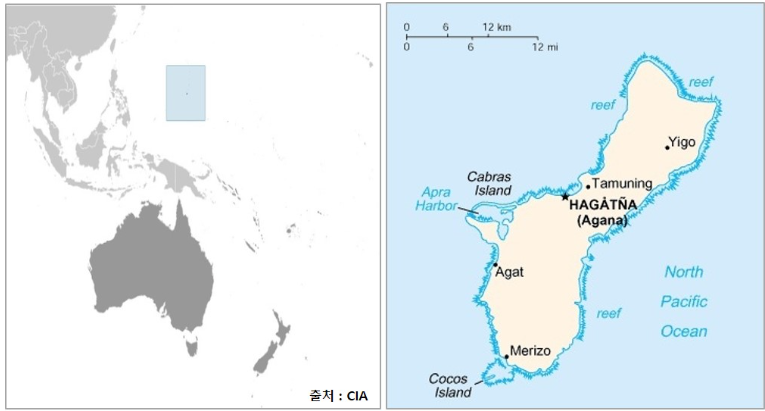
Area | 544㎢, The largest island in the Mariana Islands in the western Pacific.
Capital City | Aganya (147,000)
People Groups | Total 15 groups, Micronesians (Chamorro 40.6%, Chuuki 8.5%) 50%, Asians (Filipino 29%, Korean 2.4%) 36%, Americans 9%
Unreached People Groups | 1 (Japanese 2,700)
Official Language(s) | English, Chamorro
Total Languages | 15
Bible Translations | Completed 9, New Testament 3
Religion | Christianity 92.6% (Protestant 11%, Catholic 65%), Non-religious 3%, Buddhism 1.9%, Ethnic religion 1.4% Evangelicalism 15.9% 26,000
》 About Guam
Guam was first settled by the native Chamorro people in ancient times. In the 1000s, Micronesians and Southeast Asians migrated to the island. Chamorro society became stratified, with elite coastal communities and lower-status inland groups. Ferdinand Magellan arrived in 1521, and Guam remained a Spanish colony for more than 300 years. Spanish rule brought disease, warfare, and severe oppression, reducing the native population from about 100,000 to fewer than 5,000 by the 1700s. In 1898, following the Spanish–American War, Guam became a U.S. territory. During World War II, Japan occupied the island, forcibly laboring many Koreans who suffered and died. In 1944, U.S. forces regained control and in 1950, Guam was designated as an organized, unincorporated territory. Today, Guam is located in a strategically important location and hosts U.S. Navy and Air Force bases and serves as the cultural and educational center of the Marianas. Residents are U.S. citizens but cannot vote in presidential elections. The U.S. president is head of state, and Lourdes Leon Guerrero has served as governor since 2019, elected to a four-year term.
Guam’s economy depends heavily on defense spending tied to the military presence, tourism, trade and services. Around 1.18 million visitors come annually, primarily from China, Japan, South Korea, and Taiwan. To diversify its economy and create jobs, Guam is developing education programs for Asian students, expanding aquaculture, growing its film industry, enhancing regional health care, and supporting small businesses.
Guam’s GDP per capita is approximately $35,600.
》 Prayer Points
1. About 85% of Guam’s native Chamorro people are Catholic, and there are over 24 Catholic churches across 19 villages. As immigrants from the U.S., Philippines, Korea, and elsewhere have increased, many Protestant churches have also been established. At the same time, cults like Mormonism, Jehovah’s Witnesses, and Baha’i are actively spreading. Many Christians still mix their faith with cultural traditions and spiritual beliefs such as animism or the worship of spirits preventing true discipleship. Let us pray that all people in Guam hear the gospel clearly and come to a genuine, rooted faith in Christ.
2. Missionaries in Guam are focused on planting churches and teaching the Bible to locals and immigrants. Groups like Elim Mission, Korean Presbyterians, and the Church of the Nazarene are active, along with Pacific Islands University, which trains future leaders. Special ministries are also serving people through addiction recovery, prison outreach, and vocational support. Let us pray that through these efforts, believers in Guam and across the Pacific grow strong in faith and live with thankful hearts in Christ.
》 Urgent prayer requests around the world need your prayer!