“May you be richly rewarded by the LORD, under whose wings you have come to take refuge!”
“May the LORD repay you for what you have done. May you be richly rewarded by the LORD, the God of Israel, under whose wings you have come to take refuge.”(Ruth 2:12,NIV)
Palau
》 Country Profile
Continent| Oceania
Population | 21,000
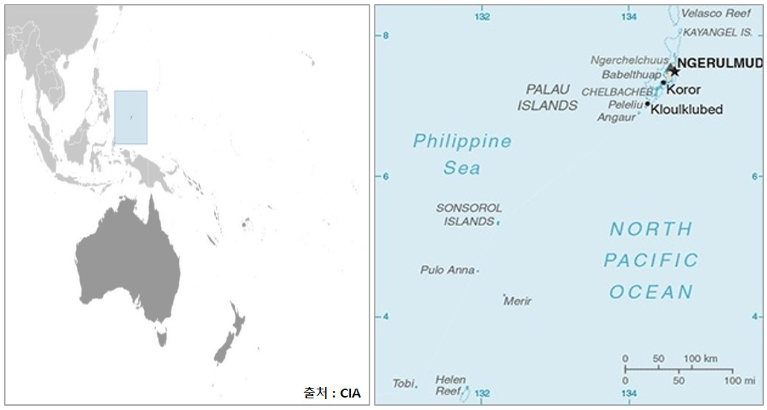
Area |459㎢, located in the western Pacific Ocean. Although Palau consists of 343 islands, only 9 are inhabited.
Capital City | Ngerulmud (approx. 300 people)
People Groups | Total 6 groups – Micronesians (Palauans 74.7%, Sonsorolese 4.7%) 80%, Filipinos 16.5%, Americans 1.2%
Official Language(s) | Palauan, English
Total languages | 5
Bible translations | Completed 2, Partial 1
Religion | Christianity 95.7% (Protestant 22%, Catholic 48%, pseudo-Christian 19%), Non-religious 1.9%, Ethnic Religion 0.8%, Evangelical 22.1% (4,600 people)
》 About Palau
Palau was first settled over 4,000 years ago by migrants from Indonesia and the Philippines. It became known to the West in the late 18th century when a British merchant ship was wrecked. Spain ruled in the 19th century, then sold Palau to Germany in 1899. Japan occupied it during World War I and used it as a naval base from 1922. In 1947, Palau became a UN Trust Territory under U.S. administration. In 1980, its constitution banned all nuclear activities. Multiple referendums delayed independence, but in 1994 Palau became a sovereign republic under a Compact of Free Association with the United States. Surangel Whipps Jr. has been President since 2021.
The economy relies on tourism, fishing, and subsistence farming. Since 1994, the government has depended on U.S. financial support—part of the Compact, U.S. provides access to Palau’s land and waters for strategic purposes. Recent U.S. funding includes $66 million for 2023 and about $889 million over 20 years under renewed Compact terms. Palau is a growing destination for East Asian tourists, aided by its strong tourism infrastructure and proximity to Guam.
Palau’s GDP per capita is approximately $15,899.
》 Scripture Focus
| Ruth 2:11-13, 20-23(NIV) 11 Boaz replied, “I’ve been told all about what you have done for your mother-in-law since the death of your husband—how you left your father and mother and your homeland and came to live with a people you did not know before.” 12 “May the LORD repay you for what you have done. May you be richly rewarded by the LORD, the God of Israel, under whose wings you have come to take refuge.” 13 “May I continue to find favor in your eyes, my lord,” she said. “You have put me at ease by speaking kindly to your servant—though I do not have the standing of one of your servants.” 20 “The LORD bless him!” Naomi said to her daughter-in-law. “He has not stopped showing his kindness to the living and the dead.” She added, “That man is our close relative; he is one of our guardian-redeemers.” 21 Then Ruth the Moabite said, “He even said to me, ‘Stay with my workers until they finish harvesting all my grain.’” 22 Naomi said to Ruth her daughter-in-law, “It will be good for you, my daughter, to go with the women who work for him, because in someone else’s field you might be harmed.” 23 So Ruth stayed close to the women of Boaz to glean until the barley and wheat harvests were finished. And she lived with her mother-in-law. |
》 Prayer Points
1.Most people in Palau are Christians, and about 48% are Catholic. But many older people follow a local religion called “Modekngei,” which mixes Christianity with magic. Many enjoy material comfort due to U.S. support but have fallen into comfort, alcohol, and careless living. The younger generation is also influenced by materialism and pluralism, resisting discipleship and commitment. On top of that, false religions like Mormonism and Jehovah’s Witnesses are active in the country. Some churches started by the German Liebenzell Mission and the YWAM base on the island are working to bring revival. Let us pray that God uses them as channels for His work. Only the New Testament has been translated into the Palauan language. The Sonsorolese and Tobian languages still need Bible translation. Also, some Uyghur detainees from Guantanamo and Burmese political refugees have settled in Palau. May they hear the gospel and come to salvation.
2. Like many islands, Palau is facing rising sea levels that are affecting both homes and the environment. In some areas, seawater comes all the way into people’s living rooms, and trees are dying. The president of Palau has warned world leaders and asked for international help, saying the country is in danger of disappearing. But there has been little response. May the people of Palau turn their fear and worry into hope for the eternal Kingdom of God. As they seek His help and protection, may they fully follow His good and faithful guidance.
Niue
》 Country Profile
Continent| Oceania
Population | 2,000
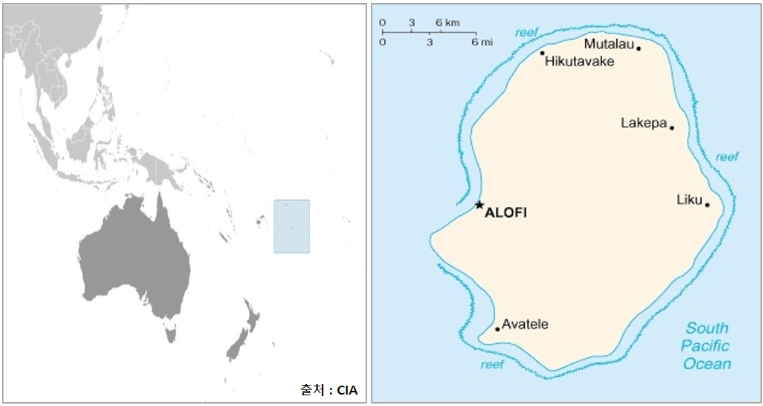
Area | 260㎢, the world’s largest raised coral atoll, located in Polynesia, South Pacific.
Capital City | Alofi (1,000 people)
People Groups | Total 2 groups, Polynesians 90%, Samoans and Tongans 10%
Official Languages | Niuean, English
Total Languages | 1 Bible Translations | Completed 1
Religion | Christianity 95.9% (Protestant 58%, Independent Churches 19%), Non-religious 3.1%, Evangelical 5.3% (approximately 100 people)
》 About Niue
Niue was settled around AD 1000 by migrants from Tonga, Samoa, and the Cook Islands. Captain James Cook explored the island in 1774. In 1846, missionary Peniamina from Samoa arrived, and in 1861 George Lawes became the first resident missionary. It became a British protectorate in 1900 and a New Zealand territory in 1901. Cultural and administrative differences led to its own self-government status in 1974. The population has declined significantly over decades due to migration to New Zealand. King Charles III remains head of state, and Dalton Tagelagi has been Prime Minister since June 11, 2020, recently re-elected in May 2023 for a term until 2026.
Economically, Niue struggles with geographic isolation, unreliable air services, limited skilled labor and business presence, poor soils, limited land, and cyclone damage. Subsistence agriculture and fishing dominate. Small processing operations export fruit, lime oil, honey, and coconut cream. Stamp sales to foreign collectors remain a key revenue source. Government expenditures exceed revenues, with deficits covered by emergency aid from New Zealand—mainly to pay public sector wages.
Niue’s GDP per capita is approximately $22,590.
》 Prayer Points
1. Niue has a long history of Christianity, and Protestant church leaders play a key role in both spiritual life and community leadership. Let us pray that the churches, believers, and leaders in Niue will be strengthened in the gospel so that the life of Christ may flow from them to others. Traditional beliefs like ancestor worship and animism still remain among the people. Let us pray that the truth of the gospel will clearly reach their hearts and bring the grace of new life.
2. Many people from Niue are moving to New Zealand, mainly to find jobs. Let us pray that they will become witnesses of the gospel there, and that revival will come to both New Zealand and their homeland, Niue. Let us also pray that more believers will rise up—not seeking personal gain, but responding to the Lord’s call. May they give their lives for God’s Kingdom and for their neighbors, even as the nation continues to face population decline and many other challenges.
》 Urgent prayer requests around the world need your prayer!