“The Middle East, go at once to seek the LORD and entreat His favor!”
and the inhabitants of one city will go to another and say, ‘Let us go at once to entreat the LORD and seek the LORD Almighty. I myself am going.’(Zechariah 8:21,NIV)
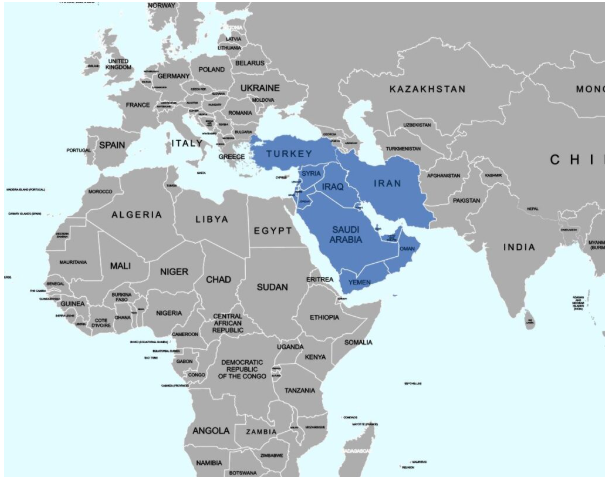
Middle East
》 Continent Profile
Continent | Middle East
Population | 297 million
Area | 7.3 million ㎢, encompassing 16 countries
Major People Groups | Arabs, Persians, Jews, Kurds
Official Language(s) | Arabic, Persian, Turkish, Hebrew
Religion | Islam 90.5%, Protestant Christianity 5.2% (Evangelical 1.5%), Judaism and Ethnic religions 1.7%, Hinduism 1.0%, Non-religious 1.0%
》 About the Middle East
The Middle East is the birthplace of some of the world’s oldest civilizations, including Mesopotamia and Ancient Egypt. It is also the cradle of the world’s major religions—Judaism, Christianity, and Islam. Today, Islam is the dominant religion in the region, which is why the Middle East is often equated with the Islamic world. The term is also often used interchangeably with “the Arab world,” though this can be misleading. While Arabs form the cultural and linguistic majority, the region is home to many non-Arab ethnic groups, such as Turks, Iranians, Israelis, and Kurds. These groups reflect the Middle East’s diverse ethnic and cultural makeup, making it distinct from purely Arab definitions.
The Middle East is one of the world’s most volatile regions, often referred to as a global hotspot. It holds significant strategic and economic importance due to its vast natural resources, especially petroleum. However, it has long been a battleground for religious, ideological, and ethnic conflicts. Many of today’s global crises—terrorism, wars, and political unrest—are linked to issues rooted in the Middle East. Recent examples include the protracted Syrian civil war and resulting refugee crisis, ongoing terrorist activities by extremist Islamic groups, and the continued conflict between Israel and Hamas.
Economy|Today, the Middle East is widely recognized as a vital hub for oil resources. The Persian Gulf region, in particular, holds about two-thirds of the world’s proven oil reserves and plays a central role in global oil production and exports. This wealth has also sparked frequent regional tensions and disputes over control of resources, often influenced by foreign investment and international political interests. However, recognizing that oil is a finite resource, many countries in the region are now pursuing economic diversification. The Middle East is emerging as a center for global logistics and civil aviation.
Religion|Except for Israel and Cyprus, all other Middle Eastern countries are predominantly Muslim. The Islamic population is divided into two main sects: Sunni and Shia. Islamic fundamentalist groups exist within both sects, though a larger proportion are found among strict Shia factions. Historically, Shia Muslims have been in the minority compared to the Sunnis, leading to ongoing power struggles. These two groups also differ in how they view the Christian world and continue to dispute the legitimacy of Muhammad’s successors. Christianity began in the Middle East in the 1st century. While Christians made up about 20% of the population in the early 20th century, today they account for just around 5%. Cyprus remains the only Middle Eastern country with a majority Christian (Orthodox) population.
》 Scripture Focus
| Zechariah 8:7–9, 16–17, 20–23(NIV) 7 This is what the LORD Almighty says: “I will save my people from the countries of the east and the west. 8 I will bring them back to live in Jerusalem; they will be my people, and I will be faithful and righteous to them as their God.” 9 This is what the LORD Almighty says: “Now hear these words, ‘Let your hands be strong so that the temple may be built.’ This is also what the prophets said who were present when the foundation was laid for the house of the LORD Almighty.” 16 These are the things you are to do: Speak the truth to each other, and render true and sound judgment in your courts; 17 do not plot evil against each other, and do not love to swear falsely. I hate all this,” declares the LORD. 20 This is what the LORD Almighty says: “Many peoples and the inhabitants of many cities will yet come, 21 and the inhabitants of one city will go to another and say, ‘Let us go at once to entreat the LORD and seek the LORD Almighty. I myself am going.’ 22 And many peoples and powerful nations will come to Jerusalem to seek the LORD Almighty and to entreat him.” 23 This is what the LORD Almighty says: “In those days ten people from all languages and nations will take firm hold of one Jew by the hem of his robe and say, ‘Let us go with you, because we have heard that God is with you.’” |
》 Prayer Points
1. The Middle East remains in constant conflict due to the complex mix of ethnic, national, and religious tensions. Civil wars in Yemen and Syria continue with no resolution, worsened by foreign intervention. Unequal power structures, poverty, and religious division—often rooted in colonial history—spark war, while economic collapse pushes frustrated youth into militias or extremist groups. Long-standing Sunni–Shia tensions, and conflicts within sects, fuel further violence. The recent Israel–Hamas war alone has claimed over 10,000 lives, with neighboring Islamic nations signaling possible involvement.
Let us pray that the selfishness of nations and the greed of leaders will be broken by the power of the gospel’s truth and justice. Let the Church, called to be a peacemaker, speak truth to its neighbors and become a bridge of reconciliation between God and sinners through the gospel. May the cross break down every dividing wall in the Middle East.
2. Years of war have created millions of refugees from Syria, Yemen, Iraq, and Palestine, many now scattered across Jordan, Lebanon, Turkey, Egypt, and Europe. They face deep poverty, limited access to education or work, and almost no chance of returning home. Many are vulnerable to child labor, sexual violence, early marriage, and exploitation. No country can fully absorb this wave of migration.
Let us pray that God becomes their refuge and hope through the Gospel’s truth and righteousness. Refugees are now more exposed to the gospel than ever before, and many are coming to faith in Christ. As this historic window for Middle East missions opens, let us cry out for the fulfillment of Zechariah 8:23, when many will seek the Lord through His people.
3. Over the past 20 years, the Christian population in the Middle East has sharply declined due to low birth rates, persecution, war, and economic hardship. Yet in countries like Turkey, Lebanon, and Jordan, churches and ministries continue to serve refugees fleeing violence. After the recent earthquake in Turkey, Christians stepped up to care for those affected. Let us pray that the remaining churches will not lose heart but rise as disciples gripped by the glory of the cross. Now more than ever, may the Church seize this open door for missions and, like the faithful of Judah, stand boldly and unashamed of the gospel, strengthening their hands to finish the race set before them.
》 Urgent prayer requests around the world need your prayer!