“Iran, trust in the name of the Lord!”
Those who know your name trust in you, for you, LORD, have never forsaken those who seek you. (Psalm 9:10,NIV)
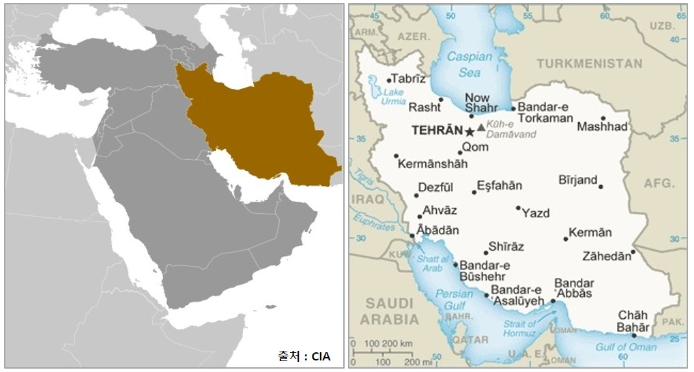
》 Country Profile
Continent | Middle East
Population | 86 million
Area | 1,648,195㎢, located between the Caspian Sea in the north and the Persian Gulf in the south.
Capital City | Tehran (9.26 million)
People Groups | Total 94 groups: Persians 45%, Azerbaijanis 19.7%, Kurds 8.7%, Gilaks 3.5%, Mazandaranis 2.9%
Unreached People Groups | 84 (99.6% of the population)
Official Language(s) | Persian
Total Languages | 81
Bible Translations | Complete 26, New Testament 5, Partial 13
Religion | Christianity 1.9% (Independent 0.6%, Orthodox 1.12%), Islam 97.5%, Other 0.3%,Evangelicals 0.5% (approximately 450,000 people)
》 About Iran
Iran has a history of over 2,500 years, beginning with the founding of the Persian Empire in 559 BC. In 1979, the Pahlavi dynasty collapsed through the Iranian Revolution, and the Islamic Republic was established under the leadership of Shia Muslim cleric Ruhollah Khomeini. Although Iran officially adopts a presidential republic system, actual authority is concentrated in the hands of the Supreme Leader and institutions that oversee the observance of Islamic law, forming a theocratic system. From 1980 to 1988, Iran fought an eight-year war with Iraq, suffering massive losses. In 2005, hardliner Mahmoud Ahmadinejad was elected president, and during his re-election in 2009, allegations of election fraud sparked nationwide protests, leading to the imprisonment or execution of thousands. Since the 1990s, Iran has pursued nuclear development in earnest. While claiming peaceful use, the international community viewed it as an attempt to develop nuclear weapons, leading the United States, the United Nations, and the European Union to impose strong sanctions. A temporary agreement was reached in 2015 through the Joint Comprehensive Plan of Action (JCPOA), but the deal was effectively nullified due to Iran’s failure to comply. In 2021, hardline conservative Ebrahim Raisi took office, further distancing Iran from the West. Internally, the country has continued to face human rights suppression, restrictions on women’s freedoms, and crackdowns on anti-government protests. The current Supreme Leader is Ali Khamenei, and the president is Masoud Pezeshkian. Iran remains in a state of instability due to ongoing nuclear issues, economic sanctions, and social unrest.
Iran’s economy heavily relies on oil and gas exports, although agriculture, manufacturing, and service sectors also play significant roles. The government directly owns and operates hundreds of state-run enterprises and indirectly controls many businesses affiliated with the military. However, issues like corruption, price controls, excessive subsidies, and a troubled banking system with billions in bad loans have held back private-sector growth. Even before the JCPOA, Iran faced low investment and declining productivity, with high unemployment particularly among women and college-educated youth. The COVID-19 pandemic in 2020 made the economic situation even more difficult.
Iran’s GDP per capita is approximately $ 4,771.
》 Scripture Focus
| Psalm 9:9–10, 15–20(NIV) 9 The LORD is a refuge for the oppressed, a stronghold in times of trouble. 10 Those who know your name trust in you, for you, LORD, have never forsaken those who seek you. 15 The nations have fallen into the pit they have dug; their feet are caught in the net they have hidden. 16 The LORD is known by his acts of justice; the wicked are ensnared by the work of their hands. 17 The wicked go down to the realm of the dead, all the nations that forget God. 18 But God will never forget the needy; the hope of the afflicted will never perish. 19 Arise, LORD, do not let mortals triumph; let the nations be judged in your presence. 20 Strike them with terror, LORD; let the nations know they are only mortal. |
》 Prayer Points
1. As more than 40 years have passed since the Islamic Revolution, a new generation is rising in Iran that is challenging the status quo. These young people, born after the revolution, now make up over half of the population. Many of them are embracing foreign influences while avoiding the reach of government control. Known as Iran’s third generation (Nasleh Sebom), they are practical-minded, seek life in the West, reject violence, and distrust government officials. Over the past decade, they have pushed for change by speaking out on democracy, women’s rights, human rights, and freedom. Their thirst for liberty has led to protests against election fraud and economic hardship, making them the primary victims of severe crackdowns. Let us pray that this new generation, thirsty for freedom, will encounter the liberating power of the gospel of the cross and return to God who never forsakes those who seek Him. Let us pray that they will rise up as a generation that acknowledges and proclaims that God alone is the Lord of all nations.
2. In October 2023, Iran was identified as the suspected backer behind Hamas’s large-scale invasion attack against Israel. This incident triggered the largest escalation between Israel and Hamas since the Yom Kippur War in 1973, causing tensions to rise dramatically across the Middle East. Iran, engaged in a regional power struggle with Saudi Arabia, is believed to have spent years preparing for this through close coordination with anti-Israel groups such as Hamas and Hezbollah, aiming to block normalization of relations between Israel and Saudi Arabia. Tensions have not eased since. In 2025, Israel has continued to launch airstrikes on Iranian-affiliated weapons depots and missile and drone bases in eastern Syria and Lebanon, causing multiple explosions. In response, Iran has issued strong warnings of retaliation. The confrontation between the two countries is escalating into increasingly direct military clashes, further destabilizing the entire Middle East. Let us pray that the Lord would rise up and reveal that no matter how powerful a nation may appear, if it turns away from God, it is still subject to His judgment. Let us pray that Iran would respond to the invitation of the great mercy of the cross extended to all humanity, overcoming judgment and becoming a nation that boasts in the cross of Christ.
3. Iran has widespread opium distribution and has the highest number of opium addicts in the world. While the Iranian government claims to crack down on drug trafficking, some powerful institutions reportedly turn a blind eye to the distribution networks, using them as a key means to secure foreign currency. In addition, following the Taliban’s return to power, about 4 million Afghan refugees who fled to Iran to escape conflict are now being forcibly deported under the pretext of strengthening national security. The Iranian government regards those who convert from Islam to Christianity as “apostates” and defines conversion itself as a threat to national security. As a result, many Christian leaders and believers have been arrested and unjustly imprisoned on charges of “violating national security.” The international community has criticized these actions by Iran as clear violations of international human rights law and religious freedom. Let us pray that the Iranian government and its leaders, who have acted without the fear of God and are entangled in their own doing, would come to fear the Lord, who is sovereign over all. Let us also pray that the gospel of the cross would be glorified in this land through the Church of the Lord, who trusts in Him as the fortress for the oppressed.
》 Urgent prayer requests around the world need your prayer!