“Cyprus, have the same mindset as Christ Jesus among you.”
In your relationships with one another, have the same mindset as Christ Jesus: (Philippians 2:5,NIV)
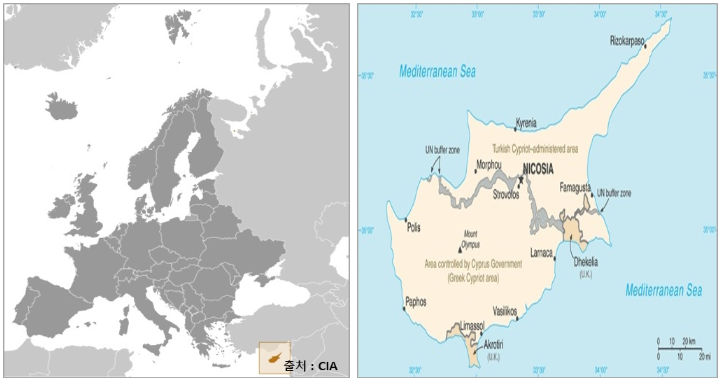
》 Country Profile
Continent | Europe
Population | 1.29 million
Area | 9,251㎢, Strategically located in the northeastern Mediterranean.
Capital City | Nicosia (270,000 people)
People Groups | Total 30 groups, Greek Cypriots 64.8%, Turkish Cypriots 18.5%, British 2.8%, Romani(Gypsy) 2.2%, Others 11.7%
Unreached People Groups | 5 (20.1% of the population)
Official Language(s) | Greek, Turkish
Total Languages | 24
Bible Translations | Completed 19, New Testament 2, Partial 1
Religion | Christianity 71.9% (Protestant 1.3%, Orthodox 63.8%), Muslim 20.4%, Non-religious 5.3%
Evangelicals | 1.3%(40,000 people)
》 About Cyprus
Cyprus came under Ottoman rule in the 16th century and later became a British colony in 1925. It remained under British military control for an extended period and resisted through various uprisings, including a notable rebellion in 1931 demanding independence. Cyprus gained independence in 1960. Following independence, tensions between the island’s Greek and Turkish communities flared. Frequent small-scale outbreaks of violence during the implementation of the new constitution created instability. As the conflict escalated into armed clashes, the United Nations intervened in 1964. This led to the de facto division of the island into two separate administrative and residential zones. In 1974, a coup backed by Greece failed, prompting Turkey to invade and partition the island. Since then, Cyprus has remained divided. The internationally recognized Republic of Cyprus, with a Greek Cypriot majority, governs the south, while the Turkish Republic of Northern Cyprus (TRNC), recognized only by Turkey, controls the north. Despite renewed efforts at unification—including negotiations in 2017—no agreement has been reached, and Cyprus remains a divided state. Nikos Christodoulidis has been serving as president since 2023. The Turkish Republic of Northern Cyprus, recognized only by Türkiye, elected Tufan Erhürman as president in 2025.
Cyprus’s economy suffered during its period of civil unrest and division but began recovering steadily in the 2000s. Tourism, finance, shipping, and real estate have traditionally been the most important industries. This economic strength enabled Cyprus to join the European Union in 2004 and adopt the euro in 2008 The island developed an excessively large banking sector relative to the size of its economy, becoming a favored tax haven for wealthy individuals from around the world, especially from Greece and Russia However, when Greece faced its own financial collapse, Cyprus could not resolve the resulting crisis. The Eurozone crisis in 2012–2013 further damaged its economy, shrinking tourism revenues and pushing unemployment rates higher. In 2013, Cyprus received a bailout from the European Central Bank and the International Monetary Fund (IMF), which helped restore gradual economic stability. Since then, the country has worked to rebuild confidence and reform its financial sector while maintaining its role as a regional hub for business and tourism.
Cyprus’s GDP per capita is approximately $37,700.
》 Scripture Focus
| Philippians 2:1–8 (NIV) 1 Therefore if you have any encouragement from being united with Christ, if any comfort from His love, if any common sharing in the Spirit, if any tenderness and compassion, 2 then make my joy complete by being like-minded, having the same love, being one in spirit and of one mind. 3 Do nothing out of selfish ambition or vain conceit. Rather, in humility value others above yourselves, 4 not looking to your own interests but each of you to the interests of the others. 5 In your relationships with one another, have the same mindset as Christ Jesus: 6 Who, being in very nature God, did not consider equality with God something to be used to His own advantage; 7 rather, He made Himself nothing by taking the very nature of a servant, being made in human likeness. 8 And being found in appearance as a man, He humbled Himself by becoming obedient to death—even death on a cross! |
》 Prayer Points
1. Cyprus is mentioned in the Bible as “Cyprus” (Kúpros in Greek), and it is the birthplace of Barnabas, one of the early church leaders in the Book of Acts. Today, Orthodox Christianity forms the cultural and religious identity of Greek Cypriots. Around two-thirds of the population identify as Orthodox, but active church attendance is mostly limited to rural areas and older generations. Though the evangelical community remains small, we give thanks to God for bringing steady growth, now numbering around 40,000. Many are from minority communities such as English speakers, Russians, Filipinos, Sri Lankans, and Iranians. Let us pray that Orthodox believers will move beyond tradition and religious formality to hear and believe in the gospel of the cross, embracing the life it offers. May Protestant churches in Cyprus be united in the same love and spirit, caring for one another, bringing joy to the Lord, and becoming channels of spiritual vitality across the island.
2. Cyprus is home to many missionary organizations and regional centers that support ministry across the Middle East. Groups such as the Middle East Christian Outreach (MECO), Campus Crusade for Christ International (CCCI), Youth With A Mission (YWAM), and Interserve are all active here. The satellite television ministry SAT-7 also operates out of Cyprus, broadcasting the gospel to the wider Arab world. Christian radio programs and printed materials are being distributed in Greek, English, and Arabic for both locals and immigrants. The island has seen a large influx of foreign workers, both legal and undocumented, from Asia, Africa, and the Middle East, and the number of refugees has risen sharply. Let us pray that missionaries and mission organizations in Cyprus would reflect the heart of Christ, boldly proclaiming the gospel to both Cyprus and the surrounding region. May the power of Christ’s humility, shown in His obedience to the point of death on the cross and in His resurrection, be proclaimed, so that the gospel may bring spiritual revival in every corner of the Middle East.
3. The Turkish Republic of Northern Cyprus, under the influence of Türkiye, is home to about 230,000 people, most of whom are Muslim though often secular in practice. The territory is recognized only by Türkiye, and is unable to operate internationally. Some residents also hold Republic of Cyprus passports. Historically, this region has been in conflict with neighboring Christian-majority Greece for centuries, and suspicion toward Christianity remains strong. Ethnic and religious prejudice continues to harden hearts against the gospel. Nevertheless, it is reported that about 0.5% of the population are Christians. Let us pray that these few believers would be true reflections of Christ—not motivated by rivalry or pride, but by humility, valuing others above themselves, and looking to the needs of those around them. May they become vessels of the gospel in this difficult environment. Let us also pray that Christ’s encouragement, love, fellowship, and compassion would reach the hearts of the people in Northern Cyprus, leading many to salvation.
》 Urgent prayer requests around the world need your prayer!