“Jesus has become the salvation of The Gambia!”
It is because of him that you are in Christ Jesus, who has become for us wisdom from God—that is, our righteousness, holiness and redemption. (1 Corinthians 1:30,NIV)
》 Country Profile
Continent | Africa
Population | 2.7 million
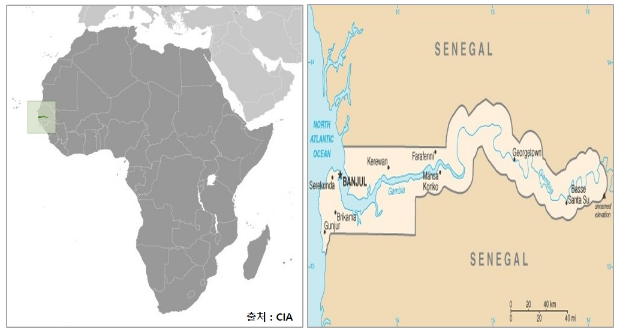
Area | 11,300㎢, Located on the Atlantic coast surrounded by Senegal in northwestern Africa
Capital City | Banjul (50,000 people)
People Groups | Total 29 Groups, Mandinka 33.3%, Fulani 18.2%, Wolof 12.9%, Jola 11%, Serahuleh 7.2%, Serer 3.5%, Manjako 2.1%
Unreached People Groups | 14 (84.7% of the population)
Official Language(s) | English, Mandinka, Wolof
Total Languages | 29
Bible Translations | Completed 11, New Testament 8, Partial 8
Religion | Christianity 3.6% (Protestant 1%, Catholic 2%), Islam 89.1%, Ethnic religions 6.5%, Evangelical 0.9% (22,000 people)
》 About The Gambia
The Gambia appeared in historical records around the 10th century when Islamic merchants settled there and established it as a key hub for trans-Saharan trade. It grew into a major center for trading gold, ivory, and slaves. From the 1660s, Britain took control of the region, and The Gambia became a major transit point in the trans-Atlantic slave trade until it was abolished in 1807. The Gambia gained independence within the British Commonwealth in 1965 and became a republic in 1970. A 1981 coup led to military intervention by Senegal, and the Senegambia Confederation was formed in 1982, but dissolved in 1989. In 1994, Yahya Jammeh seized power through a coup and maintained a long dictatorship. After losing the 2016 election, he refused to step down and fled to Equatorial Guinea following intervention by ECOWAS. The Gambia is now a presidential republic, with President Adama Barrow re-elected in 2022 to serve a second five-year term.
The economy’s main sources of income are fisheries and tourism. Seventy-five percent of the workforce is engaged in agriculture, primarily cultivating peanuts, the country’s main crop, though most are subsistence agriculture farmers. Gambia River serves as a key transportation route, as well as an important economic base for tourism due to its beautiful natural environment and diverse wildlife in the lower reaches. The country’s main exports are peanuts and seafood. Remittances from Gambians living abroad make up 20% of the national income. However, half of the population lives below the poverty line.
Gambia’s GDP per capita is approximately $888.
》 Scripture Focus
| 1 Corinthians 1:26-31(NIV) 26. Brothers and sisters, think of what you were when you were called. Not many of you were wise by human standards; not many were influential; not many were of noble birth. 27. But God chose the foolish things of the world to shame the wise; God chose the weak things of the world to shame the strong. 28. God chose the lowly things of this world and the despised things—and the things that are not—to nullify the things that are, 29. so that no one may boast before him. 30. It is because of him that you are in Christ Jesus, who has become for us wisdom from God—that is, our righteousness, holiness and redemption. 31. Therefore, as it is written: “Let the one who boasts boast in the LORD. |
》 Prayer Points
1. Most Gambians are Muslim, but many blend their faith with traditional animistic beliefs and occult practices. Protestants make up only about 1% of the population, with few churches and a very small number of committed believers. Most pastors are based in the capital, Banjul, or in urban areas, leaving many rural ethnic communities with little or no spiritual outreach. Let us pray that the small number of church leaders and pastors would be equipped with the Word and prayer, so they can boldly proclaim the gospel across the nation. The Evangelical Church of Gambia (ECG) has planted churches for converts from Islam, and the House of Wisdom helps disciple them toward spiritual maturity and self-reliance. Let us pray that Muslims living in corruption and spiritual emptiness will come to salvation through righteousness and holiness and be restored as children of God.
2. In Gambia, early missionary groups—such as Methodists, Anglicans, and Mennonites—brought development, education, and healthcare to various ethnic groups. Today, organizations like WEC and the International Mission Board (IMB) continue that mission, focusing on Bible translation, church planting, and discipleship among the Mandinka, Fulani, Jola, and Wolof peoples. In Banjul, ministries like Scripture Union (SU), Youth for Christ (YFC), and Youth With A Mission (YWAM) are reaching youth through small groups and discipleship training. Prison ministry is also bearing fruit, but many new believers need support and discipleship after their release. The gospel is being spread through diverse media—radio shows like Chronicle Bible Study and The Way of Righteous Life, TV programs like Life in the Word and Biblical Writers’ Fellowship, the JESUS film, and online platforms. Let us pray that all peoples and generations in Gambia would be set free from spiritual bondage and rise as God’s people who joyfully proclaim the gospel.
3. Women and young girls in Gambia suffer greatly from the harmful traditional practice of female genital mutilation (FGM). Around 55% of girls undergo FGM before the age of five. In 2024, parliament attempted to legalize it again, driven by some Muslim leaders and religious groups. Let us pray for the destruction of this oppressive system, that the gospel would take root in the hearts of the vulnerable, and that God’s glory would shine through their healing and restoration. Meanwhile, the next generation in Gambia faces despair due to high unemployment and limited access to education. Some fall into drug use (like cannabis and tramadol) and youth crime. Let us pray that they would encounter Jesus Christ—the true hope—and be raised as a holy generation, living according to God’s will.
》 Urgent prayer requests around the world need your prayer!