“The sun of righteousness will rise over Eswatini with healing in its wings!”
But for you who revere my name, the sun of righteousness will rise with healing in its rays. And you will go out and frolic like well-fed calves.(Malachi 4:2,NIV)
》 Country Profile
Continent | Africa
Population | 1.12 million
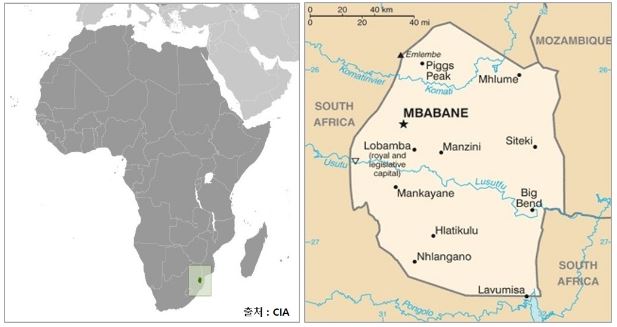
Area | 17,364㎢, Located inland between South Africa and Mozambique in southern Africa.
Capital City | Mbabane (70,000 people)
People Groups | Total 10 groups, Swazi 85.3%, Zulu 8.3%, Tsonga 2%, Afrikaans speakers 1.2%
Unreached People Groups | 1 group (0.1% of the population, about 600 Comorians)
Official Language(s) | Swati, English
Total Languages | 10
Bible Translations | Completed 8, New Testament 1
Religion | Christianity 84.1% (independent churches 48%, unregistered 18%), Ethnic religion 11.7%, Non-religious 2%, Islam 1.2%, Evangelical 20.7% (230,000 people)
》 About Eswatini
Eswatini was established in the early 19th century amid Dutch colonial expansion. In 1890, it became a joint protectorate of Britain and South Africa, then a British protectorate in 1907, and finally gained independence in 1968. Under a constitutional monarchy, King Sobhuza II ruled until his death in 1982. Queen Regent Ntombi temporarily took charge until King Mswati III ascended the throne in 1986. In response to growing calls for democracy in the early 1990s, the country held multi-party elections in 1992. Prime Minister Dlamini took office in 2003, leading the government. Although the 2006 constitution strengthened the independence of the parliament and judiciary, political parties still lack clear legal recognition. In 2018, the king officially changed the country’s name from Swaziland to Eswatini.
Eswatini has good conditions for economic growth, such as fertile land, a warm climate, and valuable minerals. However, it depends heavily on South Africa. Its currency is tied to the South African rand, meaning the country has little control over its own money system. Most people make a living through farming and raising animals. The main products sold to other countries are sugar, citrus fruits, wood pulp, and timber. Sugar and soft drink concentrates bring in the most money from exports, but a drought in 2015-16 caused a big drop in production. Many people suffer from low wages, high unemployment, and extreme poverty, especially in rural areas. The government is trying to improve roads, farming, and business opportunities while also reducing poverty and cutting spending. However, one of the biggest challenges is Eswatini’s high HIV/AIDS rate, which is the highest in the world at 26.8% and has a serious impact on the country.
Eswatini’s GDP per capita is approximately $3,936.
》 Scripture Focus
| Malachi 4:1-6(NIV) 1 “Surely the day is coming; it will burn like a furnace. All the arrogant and every evildoer will be stubble, and the day that is coming will set them on fire,” says the LORD Almighty. “Not a root or a branch will be left to them. 2 But for you who revere my name, the sun of righteousness will rise with healing in its rays. And you will go out and frolic like well-fed calves. 3 Then you will trample on the wicked; they will be ashes under the soles of your feet on the day when I act,” says the LORD Almighty. 4 “Remember the law of my servant Moses, the decrees and laws I gave him at Horeb for all Israel. 5 “See, I will send the prophet Elijah to you before that great and dreadful day of the LORD comes. 6 He will turn the hearts of the parents to their children, and the hearts of the children to their parents; or else I will come and strike the land with total destruction.” |
》 Prayer Points
1. Christianity makes up 84% of the population in Eswatini, and most believers attend worship services regularly. Public schools (elementary, middle, and high) hold mandatory worship services by royal order, and religious studies are part of the curriculum, reinforcing the country’s Christian identity. However, despite about 60% of the population identifying with independent churches and Protestantism, many follow nominal Christianity and blend traditional religious practices with their faith. The African Independent Church is the largest denomination, and some of its followers engage in polygamy, magic, ancestor worship, and even idolatrous rituals involving animal sacrifices. The Zionist movement, particularly within the ZCC (Zion Christian Church), combines syncretism with a charismatic emphasis on spiritual gifts, significantly influencing believers.
Let us pray that Eswatini’s churches will reject nominalism and syncretism, staying true to the gospel. May God instill reverence in pastors and believers, leading them to fully embrace the message of the cross and experience true transformation.
2. Foreign missionaries in Eswatini are active in training programs and radio ministries through organizations like AoG, CoN, CCCI, and the University Bible Fellowship. However, only a few ministries work directly with churches to address AIDS-related issues, and divisions sometimes arise between missionaries and local church members. Most pastors serve voluntarily, making full-time ministry difficult due to financial constraints, and many lack formal theological education. To address this, seven Bible schools and seminaries, along with Bible Extension Education (TEE) programs, are training church leaders.
A key missionary initiative is Trans World Radio (TWR), an international Christian broadcasting station, which operates from Eswatini, transmitting in 58 languages across Africa and Southwest Asia, reaching millions with the gospel. Let us pray for greater unity among missionaries, pastors, and leaders in teaching biblical truth and strengthening the church. May the church reject unbiblical teachings that prioritize spiritual gifts and miracles over sound doctrine, and may discipleship programs emerge to turn the hearts of the lost back to God.
3. According to 2018 UN statistics, over 220,000 people in Eswatini are living with HIV/AIDS. Among women over 15, one-third are infected, and at one point, the average life expectancy dropped to just 32 years. As more young adults die from AIDS, the working-age population is shrinking, and around 100,000 children have lost their parents, leaving them orphaned and struggling in poverty. The continued spread of AIDS is linked to a lack of sexual ethics among Christians, promiscuity, and polygamy.
Let us pray for the establishment of churches, hospitals, and healthcare centers to care for those suffering, bringing healing to both body and soul. May the gospel continue to reach AIDS patients, leading to a transformation of sexual ethics according to biblical truth and a change in their lives. 52% of Eswatini’s population is under the age of 24, and many young people face poverty, a 47% unemployment rate, and the devastating effects of AIDS.
Let us pray that through churches and missionary efforts, the next generation will find true hope in the gospel and rejoice in God’s love like calves leaping from the stall (Malachi 4:2).
》 Urgent prayer requests around the world need your prayer!