“Let Ethiopia say, ‘The Lord is great’”
But may all who seek you rejoice and be glad in you; may those who long for your saving help always say, “The LORD is great!”(Psalm 40:16,NIV)
》 Country Profile
Continent | Africa
Population | 113.65 million
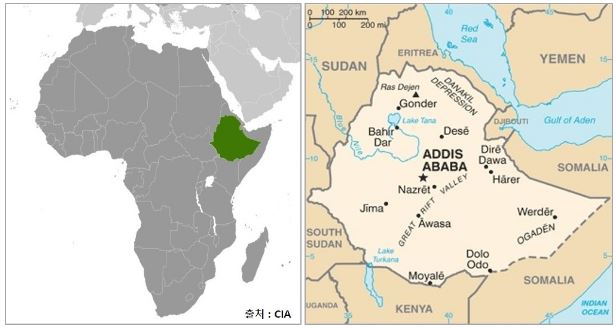
Area | 1,104,300㎢, Located in the mountainous plateau region of northeastern Africa.
Capital City | Addis Ababa (5.46 million people)
People Groups | Total 129 groups, Oromo 35.8%, Amhara 24.1%, Somali 7.2%, Tigray 5.7% Sidama 4.1%, Gamo 2.8%, Gurage 2.6%, Welayta 2.3%
Unreached People Groups | 38 (29% of the population)
Official Language(s) | Amharic, English
Total Languages | 98
Bible Translations | Completed 29, New Testament 23, Partial 21
Religion | Christianity 58.4% (20% Protestant, 37% Orthodox), Islam 32.7%, Ethnic religions 8.6%, Evangelical 18% (19.98 million people)
》 About Ethiopia
Ethiopia means “mixed race” or “land of sun-scorched faces” and was also called “Abyssinia” in Arabic. It has a long history of about 3,000 years dating back to the time of King Solomon and has remained independent except for Italian colonial rule from 1936 to 1941. In 1974, the monarchy collapsed when Emperor Haile Selassie was deposed in a military coup led by Mengistu Haile Mariam. The communist regime that followed ruled with terror, leading to the persecution of Orthodox Christians and the deaths of many people. Widespread mismanagement, coups, severe drought, famine, and a refugee crisis led to riots, and in 1991, a coalition of rebels overthrew the communist government. A border war with Eritrea in the late 1990s ended in a ceasefire in 2000 but remained a point of tension. In 2007, the Eritrea-Ethiopia Border Commission (EEBC) formally established the border, and a peace agreement was signed in 2018. In 2020, civil war erupted between the Tigray People’s Liberation Front (TPLF) and the Ethiopian government, resulting in heavy casualties and mass displacement. The conflict lasted two years before a peace agreement was reached in November 2022. However, fighting continues with the Pano militia in Amhara state and the Oromo Liberation Army in the south. The President of Ethiopia is the head of state and primarily serves a ceremonial role, while executive power is held by the Prime Minister. The current president, Taye Atske Selassie, took office on October 7, 2024, and is elected by the Federal Parliament for a six-year term.
Ethiopia’s economy is undergoing a transition, balancing public sector control with increasing privatization. Over the past 15 years, it has been one of Africa’s fastest-growing economies, yet instability and the ongoing risk of civil war create uncertainty for the future. While many government-owned properties have been privatized, major industries such as banking, telecommunications, and transportation remain under state control. The country’s primary sources of foreign revenue come from Ethiopian Airlines, a state-owned enterprise, and coffee exports, alongside agricultural products, livestock, and horticultural goods. However, Ethiopia faces a persistent trade deficit exceeding $10 billion annually. With a $1 billion Eurobond set to mature by the end of 2024, the government is making efforts to prevent default. Meanwhile, high unemployment and widespread poverty continue to challenge the nation, with 23.5% of the population living below the poverty line. Ethiopia’s GDP per capita is approximately $1,473.
》 Scripture Focus
| Psalm 40:11-17(NIV) 11 Do not withhold your mercy from me, LORD; may your love and faithfulness always protect me. 12 For troubles without number surround me; my sins have overtaken me, and I cannot see. They are more than the hairs of my head, and my heart fails within me. 13 Be pleased to save me, LORD; come quickly, LORD, to help me. 14 May all who want to take my life be put to shame and confusion; may all who desire my ruin be turned back in disgrace. 15 May those who say to me, “Aha! Aha!” be appalled at their own shame. 16 But may all who seek you rejoice and be glad in you; may those who long for your saving help always say, “The LORD is great!” 17 But as for me, I am poor and needy; may the Lord think of me. You are my help and my deliverer; you are my God, do not delay. |
》 Prayer Points
1. In Ethiopia’s northern Tigray region, a devastating civil war broke out in November 2020 between government forces and the Tigray People’s Liberation Front (TPLF). The conflict lasted for two years, claiming the lives of 500,000 people and displacing over 2 million, resulting in a severe humanitarian crisis. Although a peace agreement was signed on November 2, 2022, the situation remains unstable, with ongoing clashes involving the Fano militia in the north and the Oromo Liberation Army in the south. It is the ordinary people who suffer the most from these conflicts. As the rebels loot banks and randomly kidnap people for ransom, the government turns a blind eye, leaving citizens to bear the burden of forced payments. Let us pray that the government acknowledges its failures and takes responsibility. May the greed and power struggles that fueled this war come to an end, and may the Lord bring healing to the pain and suffering caused by the conflict.
2. Ethiopia is both a source and a refuge for displaced people. Many have fled due to ethnic conflicts and economic hardships, living in extreme poverty and uncertainty. In 2021 alone, about 56,000 refugees fled to Sudan due to the Tigray conflict. Meanwhile, Ethiopia itself hosts large numbers of refugees from neighboring countries, including Sudan, South Sudan, Eritrea, and Somalia, who are living in refugee camps. Let us pray that God raises up churches and organizations to serve these refugees with love and truth. May those who are trapped in despair find salvation in Christ and be restored to joy and hope in the Lord.
3. In 2024, Ethiopia was ranked 9th among the world’s most crisis-affected countries. Ongoing conflicts, severe droughts, and climate disasters such as El Niño-induced floods have worsened the situation. The prolonged civil war and economic mismanagement have led to skyrocketing inflation, making life even harder. In conflict zones, access to basic necessities is nearly impossible. Corruption, low labor productivity, and a weak economic system discourage foreign investment. Additionally, worsening climate conditions have intensified the food crisis. The government provides aid, but its slow distribution has failed to prevent widespread suffering. According to the UN, around 20 million people—15% of Ethiopia’s population—are in urgent need of food assistance. Let us pray that those in distress will seek the Lord, and that He will open doors for them to receive both physical and spiritual help.
》 Urgent prayer requests around the world need your prayer!