“Equatorial Guinea, belonging to Christ Jesus, has crucified the flesh with its passions and desires!”
Those who belong to Christ Jesus have crucified the flesh with its passions and desires.(Galatians 5:24,NIV)
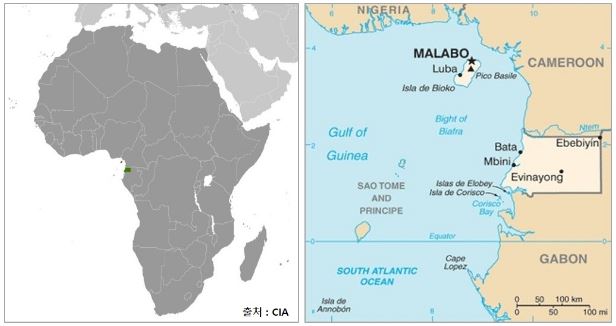
》 Country Profile
Continent | Africa
Population | 1.67 million
Area | 28,051㎢, Includes the continental areas of Rio Muni, Bioko Island, and Annobón Island on the west Atlantic coast of Africa.
Capital City | Malabo (300,000 people) – Located on Bioko Island.
People Groups | Total 18 groups, Fang 73.5%, Bubi 5%, Yoruba 4.6%, Igbo 4.2%, Seke 2.2%, Hausa 2.1%, Ngumba 1.8%
Unreached People Groups | 2 (2.2% of the population)
Official Language(s) | Spanish, French
Total Languages | 18
Bible Translations | Completed 7, New Testament 4, Partial 4
Religion | Christianity 89.3% (Protestant 3%, Catholic 84%), Ethnic religion 4.5%, Islam 3.3% Evangelical 4.7% (70,000 people)
》 About Equatorial Guinea
Equatorial Guinea was occupied by Spain in 1778, starting with Bioko Island, which was soon developed into an agricultural colony. In the 1850s, Spain expanded its colonial administration to the mainland. After 190 years of Spanish rule, the country gained independence in 1968. However, a coup in 1969 brought Macías Nguema to power, turning the nation into a brutal forced labor camp. In 1979, his nephew, Obiang Nguema, overthrew him in another coup and has ruled as a dictator for over 40 years. Due to corrupt leadership and persistent allegations of election fraud, Equatorial Guinea is considered one of the most corrupt countries in the world.
In the past, cocoa, coffee, and timber were the country’s main exports. In the 1990s, large-scale oil and gas extraction began, driving rapid economic growth and making Equatorial Guinea the African nation with the highest per capita income. However, government corruption and mismanagement of oil revenues have led to extreme income inequality. Despite its wealth, 44% of the population still lives below the poverty line. Declining hydrocarbon revenues, excessive infrastructure spending, lack of economic diversification, and persistent corruption have caused economic decline, leaving little improvement in living conditions for the people.
Equatorial Guinea’s GDP per capita is approximately $6,500.
》 Scripture Focus
| Galatians 5:19-24(NIV) 19 The acts of the flesh are obvious: sexual immorality, impurity and debauchery; 20 idolatry and witchcraft; hatred, discord, jealousy, fits of rage, selfish ambition, dissensions, factions 21 and envy; drunkenness, orgies, and the like. I warn you, as I did before, that those who live like this will not inherit the kingdom of God. 22 But the fruit of the Spirit is love, joy, peace, forbearance, kindness, goodness, faithfulness, 23 gentleness and self-control. Against such things there is no law. 24 Those who belong to Christ Jesus have crucified the flesh with its passions and desires. |
》 Prayer Points
1. Equatorial Guinea adopted Christianity during colonial rule, and about 90% of the population identifies as Christian. However, their faith is deeply influenced by animistic traditions. The country has the highest percentage of Catholics in Africa, with 84% of the population being Catholic, but most are nominal believers. Evangelicals make up about 4.7%, totaling around 40,000 people. Their numbers are gradually increasing, and religious freedom has expanded with the growth of Pentecostal, Charismatic, and Evangelical churches. Let us pray that Equatorial Guinean Christians will be taught the gospel of the cross through the Bible, be truly born again in faith, and become witnesses who crucify lust and greed(Gal 5:24) in Jesus Christ. Let us also pray that the church will stand firm against the chaos of poverty, corruption, and social inequality, fighting against desires of the flesh, walking by the Spirit and inheriting the kingdom of God.
2. Missionary organizations such as the Equatorial Guinea Mission, Youth With A Mission (YWAM), WEC, and the Assemblies of God are active in the country. More missionaries are being sent from the West, Central Africa, and Asia, for which we give thanks. Let us pray for the proper training and establishment of local church leaders through WEC and AoG’s theological education programs and YWAM’s discipleship training. May missionaries be filled with God’s wisdom to navigate political, social, and economic challenges and work in unity with local churches. The Bible Society and AoG are distributing Bibles, but there are difficulties in importing and distributing them. In 2014, the New Testament was translated into the Fang language. Let us pray that Bibles translated into local languages will quickly reach those who hunger for God’s Word and that the Holy Spirit will powerfully move as they read and understand Scripture.
3. The Fang people are the largest ethnic group in Equatorial Guinea and hold significant political power. Despite their 90% Catholic affiliation, they remain largely unevangelized. Other groups, such as the Hausa (29,000 people) who migrated from Nigeria as devout Muslims, as well as the Ngumba and Benga, also have very low exposure to the gospel. Let us pray for God to send workers who will bring the good news so that they may encounter Jesus Christ, the true light of the world. Children under the age of 15 make up about 40% of the population, yet many are neglected and fall victim to human trafficking and forced labor. Let us pray that the Equatorial Guinean government will turn away from corruption and greed, fear God, and implement policies that protect and uplift the poor and vulnerable youth.
》 Urgent prayer requests around the world need your prayer!