“Do not be afraid, for I, the Lord, will help Djibouti!”
Do not be afraid, you worm Jacob, little Israel, do not fear, for I myself will help you,” declares the LORD, your Redeemer, the Holy One of Israel.(Isaiah 41:14,NIV)
》 Country Profile
Continent | Africa
Population | 957,000
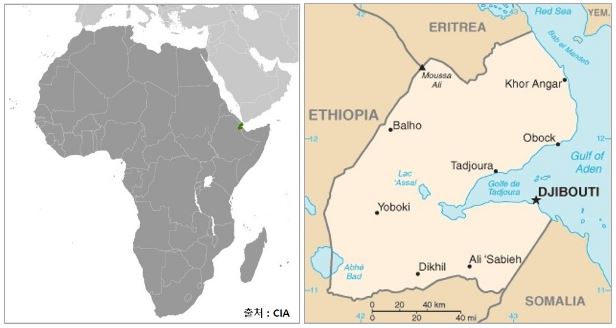
Area | 23,200㎢, Situated in Eastern Africa, Djibouti occupies a tropical desert region facing the Gulf of Aden at the mouth of the Red Sea.
Capital City | Djibouti (600,000)
People Groups | Total 11 groups, Somali(primarily Issa clan) 50%, Afar 30.2%, Arabs(Oman, Yemen) 16%, French 2.1%
Unreached People Groups | 7 groups (97.2% of the population)
Official Language(s) | French, Arabic, Somali, Afar
Total Languages | 11
Bible Translations | Completed 8, Partial 1
Religion | Christianity 2.2% (Protestant 0.2%, Catholic 1.5%), Muslim 96.2%, Non-religious 1.4% Evangelical 0.14% (1,000 people)
》 About Djibouti
Djibouti became part of French Somaliland in 1884. After holding three votes about independence, the country finally became the Republic of Djibouti in 1977. During the colonial period, the French supported the Afar minority. This caused fights with the majority Isa group. In 1981, Hassan Gouled Aptidon, from the Issa group, became the first president. When his rule became too controlling, the Afar people started a war that lasted 10 years. Until 1999, Djibouti had only one political party. Because of its location near the Red Sea and Gulf of Aden, many powerful countries have their military bases in Djibouti. This helps the country stay mostly peaceful and safe. Djibouti is a presidential republic. Ismaïl Omar Guelleh was first elected president in 1999, and in 2021, he was re-elected for a fifth term.
Djibouti is one of the hottest countries in the world. It doesn’t have much water, farmland, and natural resources. So, it depends a lot on money from France and income from foreign military bases. Djibouti is an important place for shipping. About 70% of port activities are for imports and exports, and it handles 95% of Ethiopia’s trade. It also connects trade between Europe, the Middle East, and Asia.
Recently, the country has tried to build better roads and energy systems. China is helping to expand and modernize the ports. Still, Djibouti faces big problems. Over 28% of people don’t have jobs, and about 80% of young people under 24 are unemployed. Also, 21% of the people live in poverty.
Djibouti’s GDP per capita is approximately $3,496.
》 Scripture Focus
| Isaiah 41:9-10, 14-17(NIV) 9 I took you from the ends of the earth, from its farthest corners I called you. I said, ‘You are my servant’; I have chosen you and have not rejected you. 10 So do not fear, for I am with you; do not be dismayed, for I am your God. I will strengthen you and help you; I will uphold you with my righteous right hand. 14 Do not be afraid, you worm Jacob, little Israel, do not fear, for I myself will help you,” declares the LORD, your Redeemer, the Holy One of Israel. 15 “See, I will make you into a threshing sledge, new and sharp, with many teeth. You will thresh the mountains and crush them, and reduce the hills to chaff. 16 You will winnow them, the wind will pick them up, and a gale will blow them away. But you will rejoice in the LORD and glory in the Holy One of Israel. 17 “The poor and needy search for water, but there is none; their tongues are parched with thirst. But I the LORD will answer them; I, the God of Israel, will not forsake them. |
》 Prayer Points
1. Over 96% of the population in Djibouti is Muslim, and only 2.2% is Christian. The government officially recognizes Catholic, French Protestant, and Ethiopian Orthodox churches. These churches focus mainly on helping refugees and the poor. They are also expanding their work in education, healthcare, Bible translation, literacy programs, and youth ministry. Many pastors and church workers serve under difficult physical and spiritual conditions—facing poverty, harsh environments, and ethnic tensions. Evangelical churches have been planted by immigrants from Ethiopia, Madagascar, DR Congo, Eritrea, and the Philippines, with about 1,000 believers. These churches are faithfully sharing the gospel with the Somali and Afar peoples in Djibouti. Although Christian persecution has become somewhat less intense, believers are still rejected and even threatened with violence for leaving Islam. Let us pray that the church in Djibouti will stand strong, trusting that God’s righteous right hand is holding them, and that they will live by faith in His promise: “Do not fear, for I will help you.” (Isaiah 41:10)
2. Recently, many Afar Muslims have come to faith in Jesus through dreams and visions—praise the Lord for this! Let us pray for even more gospel workers to be sent to reach the Somali Issa, Afar, Arab, and French communities with the message of the cross.
Let us pray that the church in Djibouti will boldly share the gospel with Muslim neighbors and lovingly embrace new believers as one family in Christ. May those who were spiritually thirsty and unaware of God now meet Jesus, and may they joyfully proclaim His saving grace to the nations.
3. Many refugees from nearby countries pass through Djibouti trying to reach Saudi Arabia or other nations. Sadly, many fall into the hands of human traffickers and are forced into labor or prostitution—women and children are especially at risk.
Let us pray that churches in Djibouti, placed in this strategic location, will pour out the life-giving power of the gospel to care for orphans and refugees. May the tens of thousands passing through come to know that God alone is their true help and Redeemer—and may they run toward the safest place: the kingdom of God.
》 Urgent prayer requests around the world need your prayer!