“To the believers in Tunisia, He gave the right to become children of God!”
Yet to all who did receive him, to those who believed in his name, he gave the right to become children of GOD—(John 1:12,NIV)
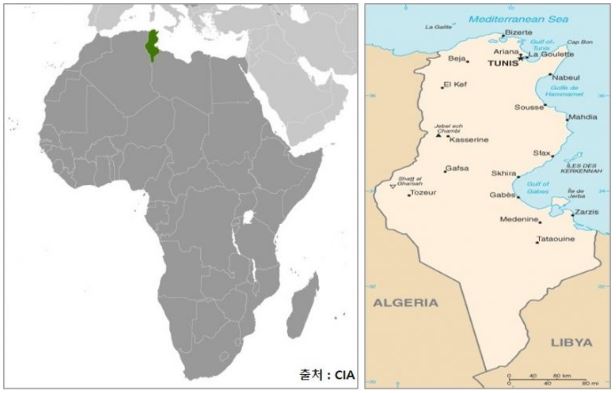
》 Country Profile
Continent | Africa
Population | 11.81 million
Area | 163,610㎢, Located on the Mediterranean coast of northern Africa.
Capital City | Tunis (2.44 million)
People Groups | Total 15 groups, Arabs 98.7%, Africans 0.8%, others 0.5%
Unreached People Groups | 12 (99.2% of the population)
Official Language(s) | Arabic, French
Total Languages | 9
Bible Translations | Completed 2, New Testament 2, Partial 1
Religion | Christianity 0.4% (Protestant 0.03%, Catholic 0.2%), Muslim 99% Evangelical 0.03% (3,500 people)
》 About Tunisia
Tunisia was the historic land where ancient Carthage once stood and the great general Hannibal was active. The region was inhabited by Berbers, and Christianity had taken root early on. However, in the 7th century, Christianity declined due to the Arab Muslim invasion. In 1570, Tunisia came under the control of the Ottoman Empire, and from 1635, a local tribal leader seized power and established a hereditary monarchy. In 1881, it became a French protectorate, and in 1956, it gained independence. The first president, Habib Bourguiba, maintained a one-party dictatorship for 31 years, suppressed Islamic fundamentalism, and introduced women’s rights at a level unprecedented in the Arab world. In 1987, power was transferred to Zine El Abidine Ben Ali through a bloodless coup. In 2010, public anger over unemployment, corruption, poverty, and rising food prices led to large-scale protests, which escalated into the 2011 revolution and resulted in the deaths of hundreds. Ben Ali fled abroad, and a transitional integrated government was established. This event was called the “Arab Spring” and sparked a wave of democratization across North Africa and the Middle East. Tunisia became a presidential republic, and Kais Saied has served as president since 2019. However, political conflict, economic hardship, and public discontent with corruption continued to fuel social unrest.
Tunisia’s economy relied heavily on exports such as textiles, food products, petroleum goods, chemicals, and phosphates, with about 80 percent going to the European Union. Since the 2011 revolution, youth unemployment remained high, and the country faced pressure to boost economic growth quickly. Although tourism made up about 15 percent of the country’s GDP, it was severely affected by repeated terrorist attacks and strikes in the phosphate sector. In 2017, the economy showed a growth rate of 2.0 percent, driven by recovery in agriculture, tourism, and export-oriented manufacturing, especially in electronics and machinery.
Tunisia’s GDP per capita is approximately $4,350
》 Scripture Focus
| John 1:9–14(NIV) 9 The true light that gives light to everyone was coming into the world. 10 He was in the world, and though the world was made through him, the world did not recognize him. 11 He came to that which was his own, but his own did not receive him. 12 Yet to all who did receive him, to those who believed in his name, he gave the right to become children of GOD— 13 children born not of natural descent, nor of human decision or a husband’s will, but born of GOD. 14 The Word became flesh and made his dwelling among us. We have seen his glory, the glory of the one and only Son, who came from the FATHER, full of grace and truth. |
》 Prayer Points
1. Only 0.4% of Tunisia’s population is Christian, and evangelicals account for just 0.03%, about 3,500 people. Tunisia is one of the most unreached countries among Islamic nations. Since the Arab Spring in 2011, internet freedom has expanded, and opportunities for religious dialogue have increased. The Tunisian government continues to be influenced by democratization and leans more toward secularism than Islamic fundamentalism. Churches mostly rent worship spaces from foreign congregations or meet in house church settings. In the capital, regular worship gatherings take place, but believers in rural areas face major restrictions and maintain their faith in isolation. The Protestant denominations include the Anglican Church and the French Reformed Church, but most of their members are nominal Christians, and few have maintained their faith for more than 10 years. This is due to spiritual and cultural pressure and opposition from families. Nevertheless, we’re thankful that new believers and new churches have continued to emerge steadily in recent years.
2. There are relatively many missionaries from abroad in Tunisia compared to the number of churches. However, there is a need for more faithful gospel workers who are fluent in Arabic. These workers can serve in areas such as education, development, healthcare, and relief. It is important that they come together with local Christians to serve their Muslim neighbors wisely and share Jesus Christ. It’s also important that Tunisian Christians need to take courage in sharing the gospel without being overwhelmed where 99% is Muslim. For the Muslims who are difficult to reach directly, the gospel can be delivered through the internet, satellite television, and radio. Let us pray that the spiritual darkness covering this land will be lifted and that the grace and glory of confessing Jesus Christ as Savior will fill the nation.
3. About 38% of Tunisia’s population is under the age of 24. These young people had high hopes for the Arab Spring but now feel disappointed with the unchanged society and are disillusioned with Islam. Youth unemployment reaches about 35%, and many are in a state of discouragement. For women in Tunisia, they enjoy more freedom than those in most Muslim countries, actively participating in politics, labor, education, and the economy. However, cultural and traditional restrictions still make it difficult to share the gospel with them. Many women also suffer from divorce and domestic violence. Let us pray that the light of Jesus Christ will shine on the youth and women of Tunisia. Let us pray that they believe in Jesus and receive the power to become children of God, so they may be the ones to bring transformation to Tunisia. Since 2011, about 520,000 Libyans and 280,000 Algerians have entered Tunisia. These groups have a higher rate of gospel exposure than native Tunisians. The Berber people, now called Amazigh, make up about 0.3% of the population. Their ancestors were Christians, but today they are almost entirely Muslim with very few Christian believers. Let us pray that God will send workers to share the gospel with the Libyans, Algerians, and the Amazigh people, so that they may hear the gospel and be saved.
》 Urgent prayer requests around the world need your prayer!