“Christ Jesus has set you free from the law of sin and death!”
because through Christ Jesus the law of the Spirit who gives life has set you free from the law of sin and death.(Romans 8:2,NIV)
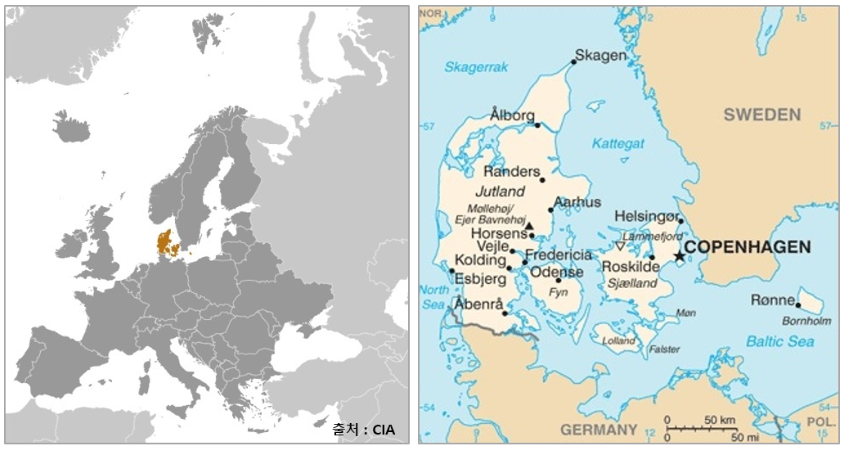
Denmark
》 Country Profile
Continent | Europe
Population | 5.92 million
Area | 43,094㎢, Consists of the Jutland Peninsula on the North Sea coast of northern Europe and islands to the east.
Capital City | Copenhagen (1.37 million)
People Groups | Total 86 groups, Danish 85.3%, Turks 1.3%, South Asians 0.9%, Poles 0.8%
Unreached People Groups | 24 (5.1% of the population)
Official Language(s) | Danish
Total Languages | 68
Bible Translations | Completed 55, New Testament 7, Partial 6
Religion | Christianity 81.6% (Protestant 74%, Catholic 3%), Non-religious 11.8%, Islam 6%, Buddhism 0.6%, Evangelical 3.6%(210,000 people)
》About Denmark
Denmark became an independent nation around the 9th century and emerged as a major power ruling much of Northern Europe during the 13th and 14th centuries. After Sweden gained independence in 1523 and Denmark lost Norway in the 1814 defeat during the Napoleonic Wars, the modern Danish state began to take shape. In 1849, the Oldenburg dynasty introduced a liberal constitution that abolished absolute monarchy and established a parliament, shifting to a constitutional monarchy. In 1901, Denmark adopted a cabinet system and granted women the right to vote in 1915, marking the modernization of its parliamentary democracy. It joined the European Union in 1973 and has since served as a bridge between the Nordic region and mainland Europe. Denmark also governs two autonomous territories: Greenland and the Faroe Islands. It is a parliamentary constitutional monarchy, with Queen Margrethe II ascending the throne in 1972. Prime Minister Mette Frederiksen has been in office since 2019 and was re-elected following early elections in November 2022.
Denmark’s economy is well known for its dairy industry and has strong food, steel, chemical, and machinery sectors. The country also has a robust fishing industry. Its advanced economy is driven by global leaders in pharmaceuticals, shipping, renewable energy, and high-tech agriculture. Citizens enjoy a high standard of living, supported by an extensive welfare system and equitable income distribution. Denmark is a net exporter of food, oil, and gas, though its manufacturing relies heavily on imported raw materials. While a member of the EU, it is not part of the eurozone. Among EU nations, Denmark recovered most effectively from the COVID-19 economic downturn. However, an aging population remains a long-term challenge. Denmark’s GDP per capita is approximately $71,851.
》 Scripture Focus
| Romans 8:1-8(NIV) 1 Therefore, there is now no condemnation for those who are in Christ Jesus, 2 because through Christ Jesus the law of the Spirit who gives life has set you free from the law of sin and death. 3 For what the law was powerless to do because it was weakened by the flesh, God did by sending his own Son in the likeness of sinful flesh to be a sin offering, and so he condemned sin in the flesh, 4 in order that the righteous requirement of the law might be fully met in us, who do not live according to the flesh but according to the Spirit. 5 Those who live according to the flesh have their minds set on what the flesh desires; but those who live in accordance with the Spirit have their minds set on what the Spirit desires. 6 The mind governed by the flesh is death, but the mind governed by the Spirit is life and peace. 7 The mind governed by the flesh is hostile to God; it does not submit to God’s law, nor can it do so. 8 Those who are in the realm of the flesh cannot please God. |
》 Prayer Points
1. Most Danish Christians are nominally Lutheran, but about half identify as atheists or agnostics. The church mainly functions as a government department under the Ministry of Ecclesiastical Affairs (Kirkeministeriet). Regular attendance at worship services is rare, with most people only visiting church for life events like baptisms, weddings, funerals, or Christmas. Organizations such as the Home Mission, the Lutheran Mission, the Oase Mission, and the Evangelical Lutheran Mission have been formed to revive Lutheranism. Though new ministers are stepping up, the number remains insufficient, and many believers are not being nurtured in the truth of the gospel. God sent His Son in the likeness of sinful flesh and condemned sin in the flesh so that the Danish people might live not according to the flesh, but according to the Spirit. Let us pray that the church would believe this complete gospel as written in Scripture, and rise again as a channel to save those who live according to the flesh and are heading toward death.
2. Some young Danes have received a vision for overseas missions, undergone training, and are now serving abroad. Their commitment is impacting the country’s traditionally non-missionary theological circles and challenging churches that have lost their vitality in evangelism and missions. Meanwhile, the influx of migrant workers and refugees is opening up vast new mission opportunities. There are now hundreds of immigrant churches, and about one-third of Christian immigrants regularly attend churches led by foreigners. The gospel needs to reach tens of thousands of Muslim Turks, Arabs, Pakistanis, Iranians, and Chinese living in Denmark. Muslims, who make up 6% of the population, began to assert their voices on major issues like press freedom and religious critique. Denmark, once known for being among the first to welcome refugees, has since shifted to a strict immigration policy that now turns many away. Let us pray that the Danish church will be transformed by the gospel, become spiritually minded, and spread life and peace. May Denmark become a nation that loves God and neighbor and lives in a way that pleases God.
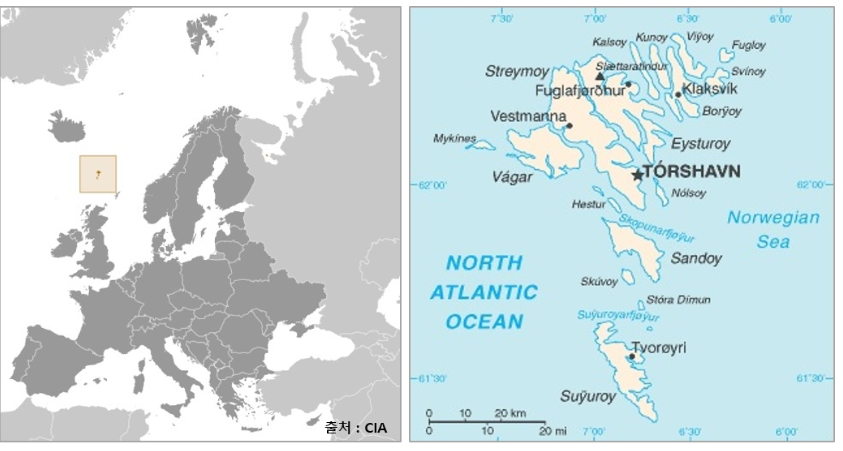
Faroe Islands
》 Country Profile
Continent | Europe
Population | 52,000
Area | 1,393㎢, Located in the northern Atlantic Ocean, between Iceland and the Shetland Islands.
Capital City | Tórshavn (21,000)
People Groups | Total 3 groups, Faroese 96%, Danish 2.6%, other 1.4%
Unreached People Groups | 0
Official Language(s) | Faroese, Danish
Total Languages | 3
Bible Translations | Completed 2
Religion | Christianity 90.9% (Protestant 88%), Non-religious 9.1%, Evangelical 33% (16,000)
》About The Faroe Islands
The Faroe Islanders are mostly descendants of Viking settlers who arrived in the 9th century. They have been a self-governing territory within the Kingdom of Denmark since 1948 and gained authority over foreign affairs in 2005. The territory consists of 21 volcanic islands, 17 of which are inhabited.
The core industries are fishing, whaling, and sheep farming, with exports focused on frozen fish and dried pollack. The fishing sector makes up around 97% of exports and about half of the gross domestic product (GDP). Annual subsidies from Denmark account for roughly 11% of the GDP. Emerging industries include financial services, oil-related businesses, shipping, marine manufacturing, civil aviation, IT, telecommunications, and tourism. The Faroe Islands’ GDP per capita is approximately $71,774.
》 Prayer Points
1. Unlike mainland Denmark, the Faroe Islands have a high proportion of evangelicals—around 33% of the population. Despite their small size, the islands are actively engaged in missions, with evangelical churches sending missionaries both domestically and internationally. They are rich in Christian resources, including two Faroese Bible translations, Lindeen Christian Radio, Ichthus Christian TV, the Faroe Online Bible, and Christian bookstores. The Pietist Home Mission is growing steadily, with dozens of prayer centers and more than 5,000 members. Let us pray that the churches in the Faroe Islands will boldly proclaim that the law of the Spirit of life in Christ Jesus has set sinners free from the law of sin and death.
》 Urgent prayer requests around the world need your prayer!